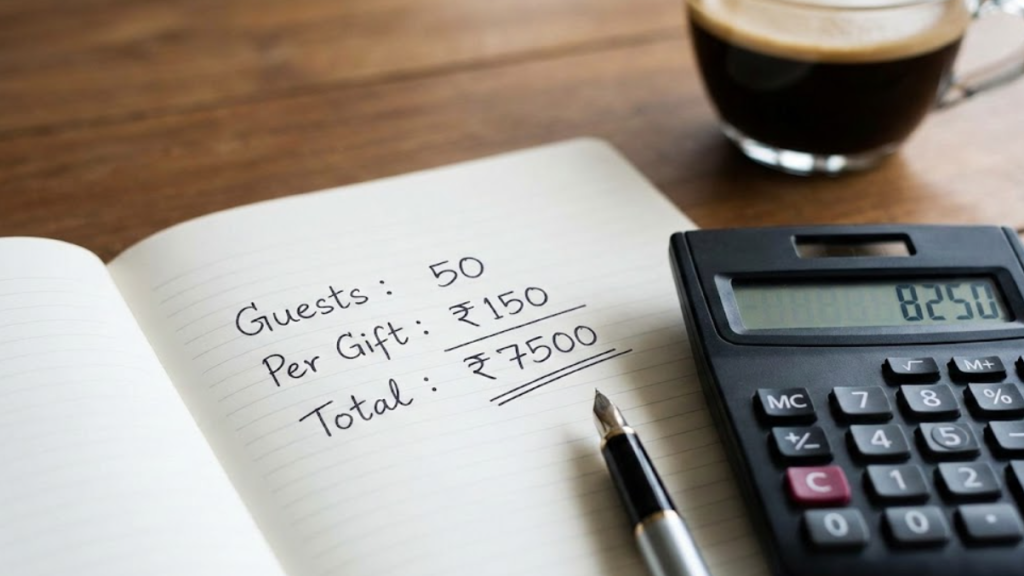
Last month, my neighbor hosted her daughter’s 5th birthday party. She bought exactly 30 return gifts for 30 confirmed kids. Guess what happened? Three siblings showed up unannounced, and one gift box got crushed when someone stepped on it. She ended up scrambling to the nearby store at the last minute, buying whatever she could find.
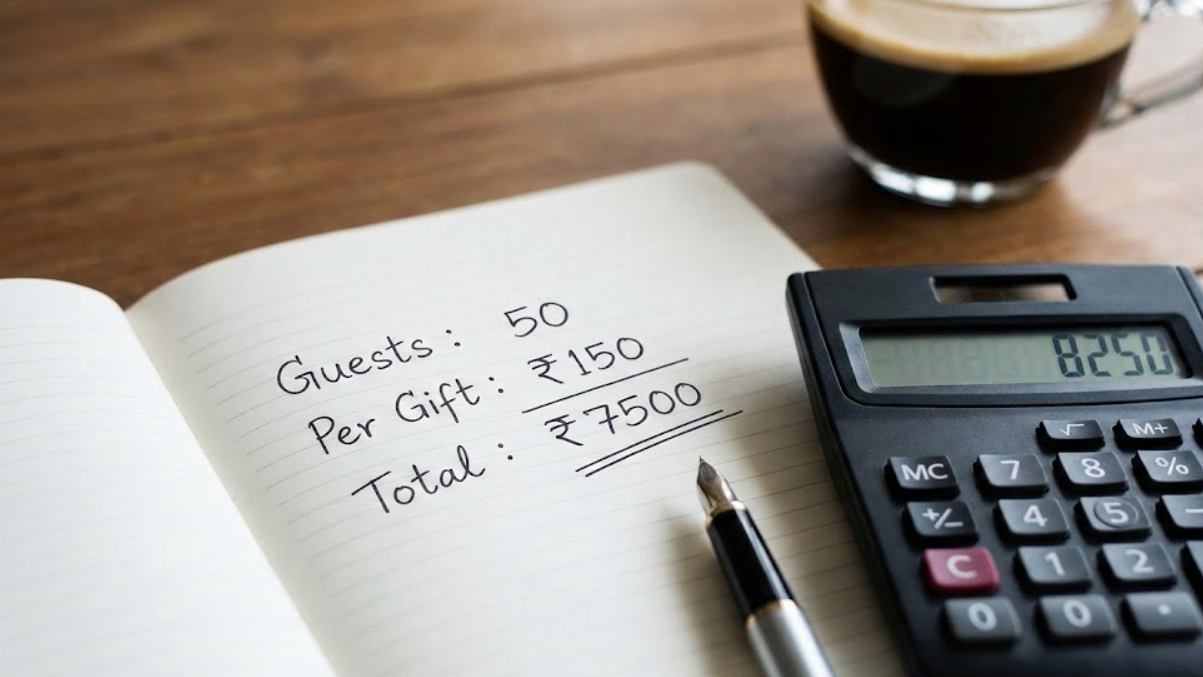
This happens more often than you’d think. Most of us either buy too few gifts and panic, or buy way too many and wonder what to do with the extras. After organizing multiple events over the years—and learning from plenty of mistakes—I’ve figured out a simple method that actually works.
Let me walk you through exactly how to calculate your return gift budget without the guesswork.
Why “Just Pick a Number” Doesn’t Work
Here’s what usually happens: You decide you want to spend ₹150 per gift. Sounds reasonable, right? Then you realize you have 80 guests coming, so that’s ₹12,000. But wait—you also need gift bags, ribbons, thank-you tags, maybe some customization. Suddenly your “₹150 per gift” budget has ballooned to ₹18,000, and you’re wondering where you went wrong.
Or the opposite happens. You set aside ₹8,000 total for gifts but haven’t thought about how many people are actually coming. You buy 50 gifts, then realize 65 kids confirmed. Now you’re either buying more at retail prices (expensive) or giving smaller gifts to some kids (awkward).
The real trick is calculating backwards: total guest count first, then per-gift amount based on your overall budget.
The Real Formula That Works
After helping friends and family plan multiple events, here’s what I’ve learned works best:
Step 1: Figure out your realistic guest count (I’ll show you how)
Step 2: Add a safety buffer of 10-15%
Step 3: Decide your per-gift budget based on event type
Step 4: Calculate total, then add 20-25% for packaging and hidden costs
Let me break each step down with actual examples.
Step 1: Get Your Actual Guest Count (Not Your Hopeful Count)
This is where most people mess up. You send out 50 invitations, and mentally start planning for 50 gifts. But that’s not how Indian parties work.
Here’s what you need to count:
Confirmed RSVPs – Kids whose parents have actually said “Yes, we’re coming.” In my experience, if you invite 50 kids to a birthday party, you’ll get about 30-35 confirmed RSVPs.
Siblings – This is huge. If you’re hosting a kids’ party, assume 15-20% of confirmed guests will bring a younger or older sibling. So for 30 confirmed kids, plan for 4-6 extra siblings.
Last-minute additions – Always happens. A neighbor drops by, a cousin shows up unexpectedly. For kids’ parties, add 5%. For weddings, add 10-15%.
Real Example: Kids’ Birthday Party
-
Invitations sent: 50
-
Confirmed RSVPs (2 weeks before party): 28 kids
-
Expected siblings (20% of 28): 6 kids
-
Last-minute additions (5%): 2 kids
-
Total to plan for: 36 gifts
But we’re not done yet. Add your safety buffer.
Step 2: Add Your Safety Buffer (The 10-15% Rule)
This buffer covers:
-
Damaged gifts (packaging gets crushed, items arrive broken)
-
Quality control (some items in a bulk order might be defective)
-
Gifts for helpers (if you want to thank the decorator, caterer’s staff, etc.)
-
One for yourself (many parents keep one return gift as a memory)
Using our birthday example:
-
Base count: 36 gifts
-
10% buffer: 4 more gifts
-
Final count to purchase: 40 gifts
Now that you have your number, let’s talk money.
Step 3: Decide Per-Gift Amount Based on Event Type
This is where 2026 reality hits. After checking current market prices from multiple vendors, here’s what you can actually expect to spend:
Kids’ Birthday Parties (Ages 3-12)
Budget range: ₹100 – ₹350 per child
-
₹100-150: Simple options like stationery sets, small toys, chocolate boxes. My friend recently got 40 pieces of customized theme boxes with chocolates for ₹115 each
-
₹200-300: Mid-range gifts like craft sets, educational toys, LED watches (currently ₹70-80 each in bulk), theme-based hampers. This is the sweet spot most parents aim for
-
₹300-500: Premium options with customization, branded items, quality wooden toys
Adult Birthday Parties
Budget range: ₹150 – ₹400 per person
Think practical items—scented candles (₹80-250 each), keychains with customization (₹50-100), potli bags with dry fruits (₹200-350), small indoor plants (₹150-300).
Weddings (This Gets Complicated)
Budget range: ₹200 – ₹1,500+ per guest
Weddings have tiers. My cousin’s wedding last year had three categories:
-
General guests (₹250-400): Decorative diyas, small brass items, chocolate boxes with names printed
-
Close family/friends (₹500-800): Potli bags with cashews/almonds, silver-plated items, customized hampers
-
VIP guests (₹1,000-2,500): Premium gift boxes, copperware, luxury candles, personalized wooden items
The average across all guests came to about ₹450 per person for 300 guests.
Current market insight: Traditional items like brass Ganesha idols start at ₹65-80, bangle boxes are ₹65-100, potli bags range from ₹47-250 depending on quality.
Baby Showers (Godh Bharai)
Budget range: ₹200 – ₹500
These tend to be smaller, more intimate gatherings. Common gifts include kumkum boxes (₹60-120), small pouches with traditional items, sweet boxes.
Step 4: Calculate Total Budget (With Hidden Costs)
Here’s where people get shocked. You think you’re spending ₹150 per gift, but you’re actually spending closer to ₹190-200 by the time you’re done.
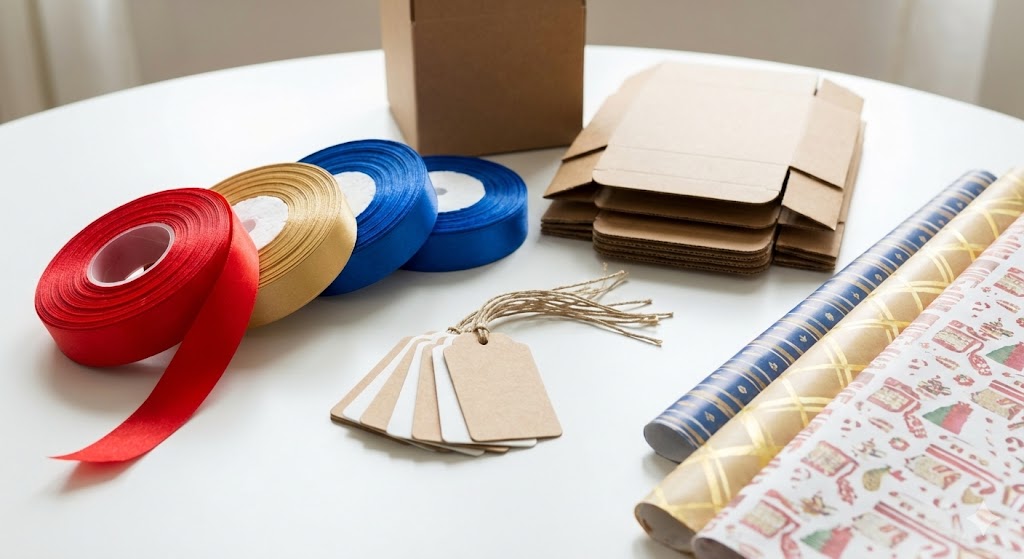
The Hidden Costs Nobody Warns You About
Packaging materials:
-
Gift bags/boxes: ₹15-40 per piece (if not included)
-
Ribbons and decorative elements: ₹5-15 per gift
-
Thank-you tags: ₹3-8 each
-
Potli bags for weddings: ₹47-400+ depending on quality
Customization charges:
-
Name printing on gifts: ₹20-50 per item
-
Photo printing: ₹30-60 per item
-
Event date/message printing: ₹25-45
Transportation:
-
Delivery charges from online vendors: ₹100-500
-
Fuel if you’re picking up from wholesale market
-
Auto/cab fare if items are bulky
Last-minute emergency fund: Always keep ₹1,000-2,000 extra for genuine emergencies.
Also Read,
Estimate your guest count using the +10% rule
Real Budget Calculation: Kids’ Birthday Example
Let’s calculate for our 40-gift scenario:
-
Base gift cost: ₹200 × 40 = ₹8,000
-
Gift bags/packaging (₹25 each): ₹1,000
-
Customization (name printing, ₹30 each): ₹1,200
-
Ribbons/tags: ₹400
-
Transportation: ₹300
-
Emergency buffer (5%): ₹550
Final Total: ₹11,450 (That’s ₹286 per gift, not ₹200!)
Real Budget Calculation: Medium Wedding (250 guests)
-
Average gift cost: ₹400 × 250 = ₹1,00,000
-
Add 15% for walk-ins: 38 extra gifts × ₹400 = ₹15,200
-
Subtotal: ₹1,15,200
-
Packaging/potli bags (₹50 avg each × 288): ₹14,400
-
Customization (names, ₹40 each): ₹11,520
-
Transportation/delivery: ₹2,500
-
Emergency fund (5%): ₹7,200
Final Total: ₹1,50,820 (That’s ₹523 per guest, not ₹400!)
Common Mistakes I’ve Seen (And Made Myself)
Mistake #1: Buying exact count – My sister did this for her son’s party. Bought 25 gifts for 25 kids. Three siblings showed up, one gift broke. Chaos.
Mistake #2: Shopping too late – Wholesale vendors need 10-15 days for bulk orders with customization. Last-minute orders mean paying retail prices (30-40% more expensive).
Mistake #3: Ignoring age differences – Giving the same return gift to a 3-year-old and a 10-year-old doesn’t work. Either buy different gifts for different age groups, or pick age-neutral items like chocolates.
Mistake #4: Forgetting packaging quality – You spent ₹300 on a nice gift but put it in a ₹10 cheap plastic bag. It looks like a ₹100 gift now.
Mistake #5: Not checking minimum order quantities – Many wholesale vendors have minimum orders of 24, 50, or 100 pieces. If you need 35 gifts, you might have to buy 50.
Money-Saving Tips That Actually Work
Buy in bulk – Most vendors offer 15-30% discounts on orders above 50-100 pieces. For our wedding, buying 300 pieces dropped the per-gift cost from ₹450 to ₹320.
Order early – Prices go up 20-30% during wedding season (November-February) and festival times. My friend ordered Diwali gifts in August and saved ₹6,000 on 100 pieces.
Skip unnecessary customization – Name printing sounds nice but adds ₹30-50 per gift. For large weddings, a simple thank-you tag works just as well and costs ₹5.
Mix and match price points – For weddings, give premium gifts (₹800-1,200) only to close family (30-40 people) and standard gifts (₹300-400) to everyone else. This balances your budget.
Buy packaging separately – Many times the “packaged” version costs ₹50 more per piece. Buy plain items in bulk, then get potli bags or boxes separately for ₹20-30 each.
Quick Reference: Budget Calculator
Here’s a simple way to calculate on the spot:
Formula: (Guest Count + 10%) × Per-Gift Cost × 1.25 = Real Total Budget
The “1.25” multiplier adds 25% for all hidden costs.
Examples:
-
30-kid party, ₹200/gift: (30 + 3) × 200 × 1.25 = ₹8,250
-
100-guest wedding, ₹400/gift: (100 + 10) × 400 × 1.25 = ₹55,000
-
200-guest wedding, ₹500/gift: (200 + 20) × 500 × 1.25 = ₹1,37,500
My Personal Checklist (Print This)
Before you start shopping:
✅ Confirm guest count 2 weeks before event
✅ Add 10-15% buffer to that number
✅ Decide per-gift budget based on event type
✅ Multiply by 1.25 for hidden costs
✅ Check vendor minimum order quantities
✅ Order 3 weeks ahead if customization needed
✅ Keep ₹1,000-2,000 emergency fund
✅ Buy extra packaging materials (they always run short)
Final Thoughts
Here’s what I wish someone had told me before my first big event: the gift itself is only 75-80% of your actual cost. The rest goes to packaging, customization, transport, and those inevitable last-minute surprises.
Start with your guest count, add buffers, calculate honestly, and don’t forget the hidden costs. That’s it. You’ll never run short, never overspend wildly, and never have that panicked moment of “What do I give this unexpected guest?”
What about you? What’s your go-to per-person budget for return gifts? Have you ever had a gifting disaster at a party? Drop a comment below—I’d love to hear your stories!