There’s a family in our extended circle—lovely people, genuinely warm—who I’ve quietly dreaded exchanging gifts with for the last four years.
It started innocently at their son’s wedding. My wife and I brought a thoughtful shagun of ₹5,100 and a nice gift set. Their return gift to us was a beautifully packaged hamper that clearly cost ₹800–1,000. We felt slightly outgiven but didn’t think much of it.
Six months later, their daughter’s engagement. We upgraded our shagun to ₹7,100. Their return gift: an engraved copper bottle set, easily ₹1,200.
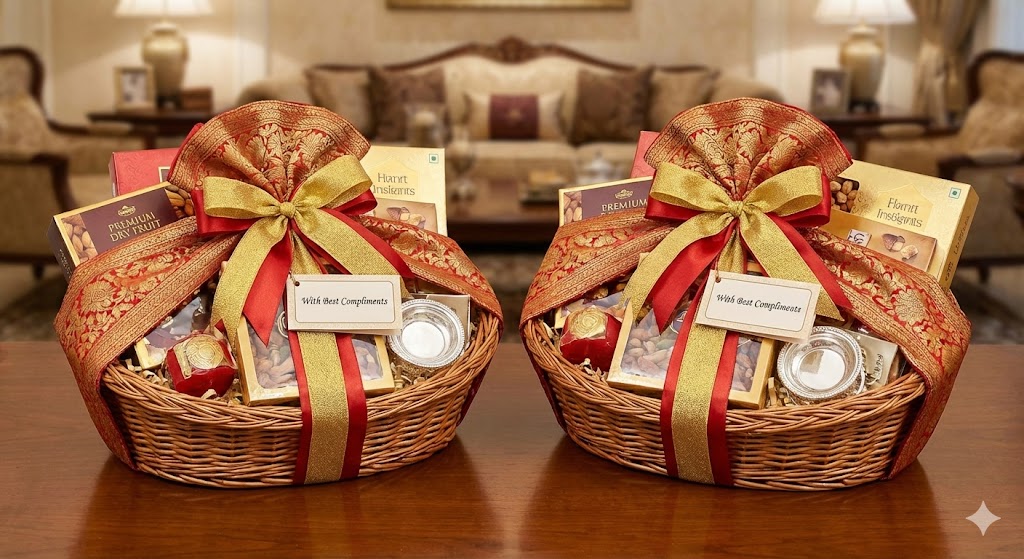
Then our son’s birthday. They sent a gift worth ₹1,500 with a handwritten card. We spent three evenings anxious about what to give their daughter for her upcoming birthday—eventually landing on something ₹1,800 “so we weren’t behind.”
I realized one day that I’d stopped thinking about what would genuinely delight this family and started calculating how to stay even. Our relationship—which had been warm and uncomplicated for fifteen yea
rs—had quietly transformed into a gift ledger. Every occasion produced mild anxiety: Are we matching what they’re likely to give? Are we overgiving and creating pressure for them? Are we undergiving and signaling that we value the relationship less?
We had, without ever discussing or intending it, turned a tradition designed to create harmony into a mechanism for generating stress.
This is the central paradox of return gifting in India—and in human social life more broadly. The same act of giving that builds relationships can, if the underlying dynamic shifts, quietly corrode them.
The Three Obligations: A Framework 2,500 Years in the Making
In 1925, French sociologist Marcel Mauss published Essai sur le don (The Gift), his landmark analysis of gift exchange across cultures. He identified three universal obligations embedded in all gift economies:
1. The obligation to give
2. The obligation to receive
3. The obligation to reciprocate
What makes his framework remarkable—and specifically relevant to Indian return gifting—is that he argued these aren’t just social niceties. They are structural forces that bind communities together. The obligation to give, receive, and reciprocate creates a continuous web of mutual dependency that is the actual foundation of social cohesion.
India, it turns out, had arrived at precisely the same understanding thousands of years earlier—and built it directly into religious and philosophical teaching.
The Sanskrit concept of Danadharma (dana = giving, dharma = moral duty) frames gifting as a sacred obligation—not to any specific person, but to the social and cosmic order itself. True giving, in this framework, isn’t a choice. It’s a fulfillment of duty. The Bhagavad Gita takes this even further with the concept of Dana (selfless giving)—describing authentic giving as an act that should occur without expectation of return, as a virtue in itself.
Here is the philosophical tension at the heart of Indian return gifting: The tradition asks you to give without expectation, while simultaneously creating a social structure in which not reciprocating creates imbalance. Dana says give freely. Danadharma says fulfill your social duty. Atithi Devo Bhava says honor the guest. And somewhere in the middle of these three imperatives, modern Indian hosts navigate return gifts, shagun amounts, and gift counters at weddings.
Understanding this tension—rather than trying to resolve it—is the beginning of genuine gifting wisdom.
What Reciprocity Actually Does in Indian Social Life
Reciprocity in gift exchange serves four distinct functions in Indian society, and conflating them leads to most of the confusion and stress around return gifting:
1. Relationship Maintenance
The most fundamental function. When you give a return gift to someone who attended your function, you’re not just thanking them for this specific occasion. You’re signaling: I acknowledge your place in my life. This relationship continues. I see you.
This is why gifts flow even between families that see each other rarely—the gift is a relationship-renewal mechanism, independent of frequency of contact. A diya sent to your father’s cousin’s family in another city for their son’s wedding isn’t about that specific wedding. It’s about keeping a 40-year family connection alive across distance.
2. Social Hierarchy Communication
Gift quality and quantity have always communicated hierarchy in Indian social life—and this is not accidental. It’s a feature, not a bug.
When a host gives the pandit a visibly elevated return gift compared to regular guests, they’re not just being generous. They’re publicly acknowledging the pandit’s spiritual authority and social role. When elders receive better gifts than younger guests, it visibly affirms the family’s respect for seniority.
The problem arises when hierarchy communication becomes status competition. When families start upgrading return gifts not to honor genuine relationships but to signal economic superiority over other guests—the social function inverts. What was meant to affirm hierarchy now creates resentment.
3. Community Bonding and Continuity
Gifts at weddings, pujas, and festivals aren’t just between individuals—they’re between families, between communities, across generations.
When your family has exchanged gifts with another family at every major occasion for thirty years, something larger than individual transactions has been built. The accumulated history of giving and receiving creates a bond that new friends—despite deep personal warmth—don’t share. This is why India’s kinship networks remain so resilient across geographic distance and time apart. The gifting calendar keeps the relationship alive whether or not people see each other.
4. Spiritual Merit
This function is least discussed in modern gifting conversations but most important in the traditional framework. Danadharma teaches that the act of giving itself—regardless of what the receiver does with the gift—accrues punya (spiritual merit) for the giver.
This transforms the economics completely. In pure market logic, a return gift that gets thrown away is a waste. In Danadharma logic, the gift fulfilled its purpose the moment it was given with genuine intention, regardless of what happened to it afterward. The giver’s virtue exists independent of the receiver’s response.
This framework, if genuinely internalized, eliminates most of the anxiety around return gifting. You gave well. That’s the whole transaction.
Where Balance Breaks Down: The Obligation Spiral
Return gifting becomes psychologically harmful—and socially corrosive—when the three obligations Mauss identified lose their balance.
The Escalation Trap
An Ashoka Economics and Society blog post described it with painful precision using the Diwali example: You give Rajesh a ₹5,000 gift hamper. Rajesh feels guilty because his planned gift suddenly seems inadequate. He rushes to buy something more expensive. You receive it and feel the pressure to match or exceed at the next occasion. And so it escalates.
This is the gift economy equivalent of an arms race—and it happens in Indian social circles with remarkable regularity. Every participant feels the pressure. Nobody feels the joy. The original purpose—expressing genuine warmth—has been completely subverted.
How to recognize you’re in an escalation trap:
-
You think about gift cost before you think about what the person would actually want
-
You feel relief, not joy, when giving or receiving
-
You track approximate values of what others gave you
-
You feel anxious about being “outgiven” or “undergiven”
-
Gift exchanges have started to feel like financial negotiations
The Obligation Without Relationship Problem
Social expansion in modern India—larger wedding guest lists, office networks, building acquaintances, school-circuit relationships—has created a situation where people give and receive return gifts with people they barely know.
The original reciprocity framework assumed an ongoing relationship that the gift exchange maintained and strengthened. When you give a return gift to 200 wedding guests—many of whom are your father’s colleague’s distant relatives whom you’ve met once—the relationship maintenance function doesn’t apply. The social bonding function barely applies. You’re going through the motions of reciprocity without the underlying relationship that makes reciprocity meaningful.
This is why large wedding return gifts often feel hollow despite significant expenditure. The gift is technically correct but experientially empty—because the relationship it’s supposed to honor doesn’t really exist.
The Performance Displacement
Perhaps the most damaging shift: when return gifts stop being about the relationship and start being about the audience.
You’re no longer giving your guests a return gift because you feel genuine gratitude for their presence. You’re giving it because other people at the function are watching, because WhatsApp groups will discuss it later, because your family’s reputation as generous hosts is at stake.
The gift remains. The intention has completely changed. And guests—who are perceptive human beings—can often feel the difference between a gift given from genuine warmth and a gift given for appearance management. One creates a memory. The other creates a transaction record.
The Indian Philosophical Correction: Dana Without Expectation
The Bhagavad Gita’s teaching on dana offers the most elegant solution to the obligation spiral problem—and it’s been sitting in Indian philosophical tradition for 2,500 years, waiting to be applied.
Chapter 17, verse 20 describes the highest form of giving: “That gift which is given to one who does nothing in return, with the feeling that it is one’s duty to give and which is given at the right place and right time and to a worthy person—that gift is considered to be in the nature of goodness.”
The operative phrase: “to one who does nothing in return.”
True giving—dana in its purest form—requires releasing expectation of reciprocity. Not eliminating reciprocity as a social practice (that would tear the community fabric), but releasing your personal attachment to whether and how your giving is returned.
What this means practically for return gifting:
When you give a return gift from this orientation, you don’t track whether the family matched your generosity at their next function. You don’t mentally note that they gave you a ₹150 gift and you gave them ₹300. You gave because the occasion called for it, because your guest honored you with their presence, because expressing gratitude is its own completion.
When you receive a return gift from this orientation, you don’t evaluate it against what you gave them at their last function. You receive it with both hands, genuine warmth, and the understanding that their intention—whatever the material value—was to honor you.
This sounds idealistic. In practice it’s entirely achievable—and it’s exactly how the most gracious hosts and guests I’ve observed in Indian social life actually operate.
The Harmony Principles: Practical Application
Philosophy informs practice. Here’s how the reciprocity-balance-harmony framework translates into actual gifting decisions:
Principle 1: Give to the Relationship, Not the Ledger
The moment you start thinking “they gave us ₹X so we should give ₹Y,” you’ve entered ledger mode. Ledgers track transactions, not relationships.
The alternative: Give based on what feels genuinely appropriate for your relationship with this family. A close friend of 20 years naturally warrants more than an acquaintance of 2 years—not because of what they’ve given you, but because of the depth of the relationship itself.
If you genuinely cannot remember the last gift they gave you and have to think hard to recall—you’re probably tracking the right things. If you know their shagun amount to the rupee—you’re in ledger mode.
Principle 2: Set the Tone at Your Own Functions
The host sets the gift culture at every function they organize. A host who gives beautiful, thoughtful return gifts without obsessing over per-unit cost creates a warm gift culture. A host who sources the cheapest possible gifts while spending lavishly on food signals that return gifts are a grudging obligation.
More importantly: a host who personally thanks each guest as they receive their return gift—making eye contact, saying something specific, using the guest’s name—transforms the material transaction into a human moment. That personal warmth is the actual gift. The jute pouch is just the vehicle.
Principle 3: Never Compete Upward
If a family consistently gives more than you can comfortably match, the correct response is not to strain your budget to keep up. The correct response is to give what you genuinely can, with full warmth and zero apology.
A genuinely good relationship can absorb a gift imbalance without damage. In fact, forcing economic equality in a relationship where real economic differences exist is more dishonest—and more uncomfortable—than honest asymmetry handled gracefully.
The families I know who give the most meaningfully are often not the ones giving the most expensively. They’re the ones giving most intentionally—within their means, without performance, without tracking what they’ll receive back.
Principle 4: Break Escalation Cycles Consciously
If you recognize that you’re in an escalation trap with a specific family or social circle, you can break it. The technique is simple: give slightly less than the last exchange—but make the gift more personal, more thoughtful, more carefully chosen.
A ₹500 gift that clearly reflects knowledge of the person (their interests, their home, their current life situation) creates more warmth than a ₹1,000 generic hamper. When the other family receives it, they feel seen rather than outcompeted—and most people naturally de-escalate in response.
This requires confidence—the willingness to be the one who steps off the escalator first. But it works, and the relationship usually becomes noticeably warmer as a result.
Principle 5: Distinguish Genuine Obligation from Social Anxiety
Not all obligation is bad. The obligation to acknowledge a pandit’s role at your ceremony, to give your household help a meaningful gift on festival days, to send something to the family member who came from 500 kilometers away for your wedding—these obligations are genuine expressions of dharma. Fulfilling them feels right because they are right.
Social anxiety masquerading as obligation—the fear of what the building WhatsApp group will say, the pressure to match your neighbor’s return gift budget, the performative gifting done purely to maintain status—is a different animal entirely. It produces no genuine warmth, creates no real connection, and costs money without building anything.
The internal test is simple: Does this giving feel like an expression of genuine feeling, or does it feel like paying a social fine?
The first is danadharma. The second is social anxiety. Only one of them builds anything real.
The Social Harmony Function: Why This Matters Beyond Individual Relationships
Zoom out from individual gifting decisions and something larger comes into view.
Indian communities—joint family networks, neighborhood bonds, professional circles, religious communities—maintain their cohesion through reciprocal exchange. The gift exchange at weddings, pujas, and festivals is literally the social glue. It’s the mechanism through which hundreds of relationships are simultaneously renewed, acknowledged, and continued across a single occasion.
A wedding where 250 families receive return gifts is 250 relationship-acknowledgments happening in one afternoon. That’s not inefficiency—it’s social engineering of the highest order. Every family leaves feeling seen, honored, and connected. The community’s web of relationships has been renewed en masse.
This is why the Indian return gift tradition—despite its modern complexities and social pressures—deserves genuine respect. At its best, it does something no other social institution quite manages: it creates and maintains community belonging at scale, across every class, every occasion, and every generation.
The problem isn’t the tradition. The problem is when individual anxiety—about status, about matching, about being judged—corrupts the intention from genuine community-building into competitive performance. The tradition is designed for harmony. The corruption is designed for hierarchy.
Finding Your Own Balance
I eventually had a quiet conversation with the family I mentioned at the beginning of this article—the one with whom we’d built an inadvertent gift ledger.
I told them, over tea, that I’d noticed we seemed to be escalating and that I personally found it stressful. I said I valued our relationship far too much to keep it running on gift accounting.
The husband laughed—genuinely, with relief. “Yaar, hum bhi yehi soch rahe the. Pata nahi kab se yeh shuru ho gaya.”
(We were thinking the same thing. Don’t know when this started.)
We agreed, gently and without formality, to just give what felt right from then on—without tracking, without matching, without performance. The next occasion was their daughter’s birthday. We gave something thoughtful at about ₹400. They gave our son something lovely at ₹350. Nobody counted. Everyone was happy.
That conversation—fifteen minutes over tea, two middle-class families deciding to stop playing a game neither of them had consciously chosen to play—is the entire thesis of this article.
Return gifts are, at their deepest root, about harmony. Not performance. Not competition. Not status management. Harmony—the warm completion of a social circle that says: you were here, you mattered, I’m grateful, I honor you.
When they do that—and when you give them from that place—they work exactly as 2,500 years of Indian tradition designed them to. Every rupee spent is worth it. Every gesture lands.
When they don’t do that—when they’ve become about keeping score—no amount of money spent makes them feel meaningful. Because they’ve stopped being gifts and started being invoices.
Give from the first place. Release the second. That’s the whole practice.
Has gift exchange with a specific family or social circle ever created stress rather than warmth for you? How did you navigate it? These are the honest conversations that make our social lives more genuine—share in the comments!