Picture this: Your 6-year-old’s birthday party is in full swing. Cake’s cut, games are happening, return gifts are lined up. Then you notice little Aarav from next door—4 years old, not invited, just tagging along with his sister—standing in the corner, staring at the gift table with those big, sad eyes.
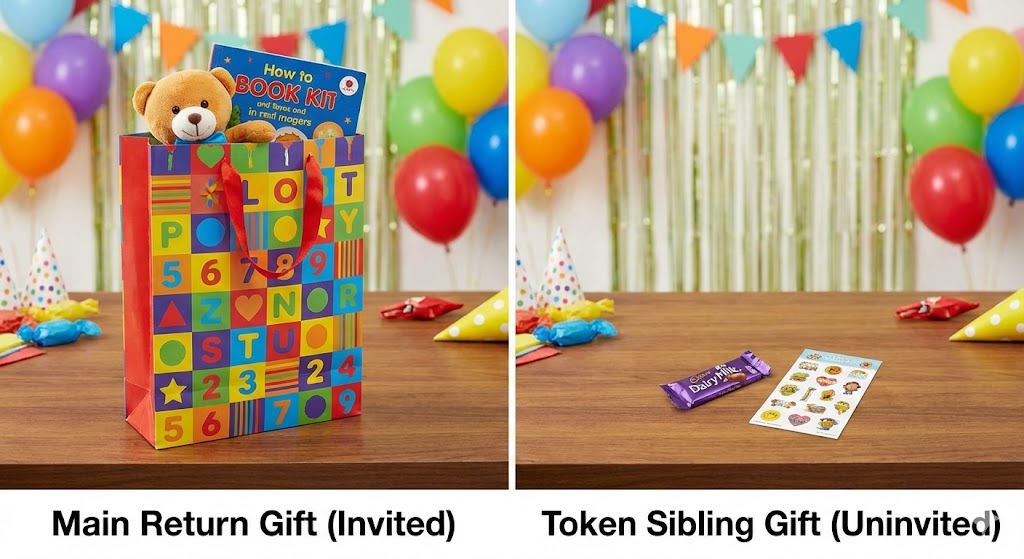
His sister got a nice stationery set. Everyone’s clapping. Aarav’s getting nothing. His mom looks awkward. You feel the pressure. Do you:
A) Hand him something from the gift pile (even though he wasn’t invited)?
B) Pretend not to notice and let it play out?
C) Pull out a secret “emergency sibling gift” you kept aside?
Every single parent who’s hosted more than two kids’ parties has faced this exact moment. And honestly, there’s no perfect answer—it’s all about your situation, your budget, and what feels right in that moment.
The Two Types of “Sibling Jealousy” Situations
First, let’s separate the two scenarios, because they’re handled differently:
Situation 1: Your Own Kids (Birthday Child + Sibling at Home)
Your 3-year-old is celebrating, but your 5-year-old sibling is watching all the gifts go to their brother and starting to pout.
Situation 2: Guest’s Uninvited Sibling (Tag-Along Kid)
You invited Priya from school. She arrives with her 2-year-old brother who wasn’t on any list.
These need different strategies.
Your Own Kids: The Jealousy Is Real (But Manageable)
With your own children, some birthday jealousy is basically guaranteed, especially when they’re under 7. Parenting coaches say it’s normal—little kids don’t grasp “it’s not your day” yet.
Here’s what actually works, based on what I’ve seen parents do successfully:
For Ages 2-4 (High Risk of Meltdown):
-
Give them one small “helper gift” early in the day, before the main celebration.
-
Frame it differently: “You’re helping your brother celebrate, so here’s your special helper treat.”
-
Examples that work: small book, coloring set, one toy—not matching the birthday child’s haul.
For Ages 5-7 (Teachable Moment):
-
Skip gifts, focus on special roles instead:
-
Let them hand out return gifts
-
Give them the “cake knife” honor
-
Make them “official party photographer” with your phone
-
-
Explain simply: “Today we celebrate your sister. Your birthday is in June—we’ll make it amazing.”
The Key Rule: Whatever you do, keep their “thing” clearly smaller than the birthday child’s. You don’t want two birthday kids.
One mom I know gives her non-birthday kids a ₹50-80 “participation treat” (like a small puzzle or book). Keeps peace without ruining the focus. Works fine.
Guest Siblings: The Etiquette Tightrope
This one’s trickier. You didn’t invite the little brother. You bought exactly enough gifts for your guest list. Now he’s here, empty-handed, while everyone else lines up.
Parenting forums are full of this debate. Here’s the consensus:
You Are NOT Obligated
Most etiquette advice says clearly:
-
Guests bringing uninvited siblings without asking is mildly rude, especially at paid venues.
-
Hosts are not expected to provide full return gifts for extras.
-
A smile, cake slice, and game inclusion is sufficient hospitality.
But a Little Kindness Goes Far
That said, nobody wants a crying 3-year-old ruining the vibe. So the practical middle ground most parents land on:
Keep 2-4 “Emergency Sibling Gifts” Aside
These are:
-
Smaller and simpler than your main return gifts
-
Neutral and safe (no allergies, no mess)
-
Kept hidden until needed
Examples for ₹30-60 range:
-
Single chocolate bar or biscuit pack
-
Small pencil + eraser set
-
One sticker sheet or temporary tattoo pack
-
Tiny coloring book
How to Handle the Moment:
-
Spot the uninvited sibling looking sad.
-
Quietly hand them an emergency gift with a smile: “Here you go, sweetie!”
-
No big announcement. No making it equal to main gifts.
-
Mom gets the message without embarrassment.
This costs you ₹120-240 max, buys massive goodwill, and keeps the party smooth.
When to Draw the Line (Protect Your Budget)
Not every situation deserves extra gifts. Be firm here:
Say No When:
-
Multiple siblings from one family show up unannounced (2+ extras).
-
You’re at a per-head venue (soft play, bowling, etc.) where each extra kid costs you ₹300-500.
-
The sibling is older than the birthday child (teen at a toddler party—different expectations).
-
You’ve already gone over budget just covering invited guests.
In these cases:
-
Offer cake, juice, and a game.
-
If they ask directly: “Sorry, we only have enough gifts for the birthday guests.”
-
Most parents understand and won’t push.
One parent shared online: “Three families brought extra siblings to my paid venue party. I politely said we only had cake and games for invited kids. No drama.”
The Venue vs. Home Party Difference
Home parties (easier):
-
More flexible space and food.
-
2-3 extra small gifts usually fine.
Paid venues (strict boundaries):
-
Extra kids = extra charges.
-
Be upfront in invites: “Party booked per invited child only” or “Drop-off for birthday child”.
-
Still keep 1-2 spares, but don’t feel guilty saying no to more.
Etiquette guides recommend this exact wording for venues where headcount matters.
Budget Impact: How Many Extras to Plan For
From real parent experiences:
-
1-2 surprise siblings is common in 20-25 kid parties.
-
3+ extras usually means loose RSVP discipline or very social circles.
Smart Planning:
-
Buy main return gifts for your final calculated guest count (+10% buffer from earlier article).
-
Add 2-3 emergency sibling gifts (₹100-200 total).
-
Don’t buy more—you’re not running a free daycare.
What About Your Own Kids Watching This?
If your non-birthday child sees you giving gifts to guest siblings, they might think: “Why did they get something and I didn’t?”
Handle with:
-
Pre-party talk: “Those kids came to celebrate you. They get a tiny thank-you. Your gifts are much bigger because it’s YOUR day.”
-
Visual difference: Make sibling/emergency gifts clearly smaller so no confusion.
-
Your consistent rule: Whether you give sibling tokens or not, stick to it every time.
The Social Pressure Trap
Some parent groups create unspoken rules: “Oh, you gave sibling gifts? Now I have to next time.”
Don’t fall for it. You set your own boundaries:
-
Home parties with good friends: 2-3 small extras is fine.
-
Large/mixed groups or paid venues: cake and hospitality only.
-
Your call, no guilt.
One mom put it perfectly online: “I spent enough on the party. Uninvited kids get to eat cake and play games. That’s generous enough.”
Simple Rules for Your Next Party
For your own kids:
-
Under 4: small helper gift + special role.
-
5+: roles and explanation, skip gifts.
For guest siblings:
-
Keep 2-3 tiny emergency spares (₹30-50 items).
-
Prioritise invited kids for main gifts.
-
Paid venues: set expectations upfront.
Budget line:
-
Main gifts: your calculated guest count.
-
Sibling buffer: ₹150-250 total, max.
This handles 95% of situations without stress, overspending, or hurt feelings.
Final Reality Check
Sibling gifts are nice-to-have kindness, not must-do obligation.
You control:
-
Your budget
-
Your party vision
-
What “celebrating” looks like
A crying 3-year-old for 2 minutes is survivable. Running out of main return gifts for invited kids is not. Prioritise accordingly.
Most parents just want their child included and happy. A slice of cake, a balloon, and your warm smile go further than you think. Save the good gifts for the people you actually planned for.
Have you faced the uninvited sibling dilemma? What did you do, and how did it go? Drop your stories below—every party host needs these real-life tips!
Pingback: Wholesale vs. Retail Return Gifts: Sadar Bazar & Parry's Guide