Two years ago, I made a mistake that still makes me cringe.
My close friend Meena’s mother was celebrating her 60th birthday. A proper, traditional celebration—130 guests, full lunch, live bhajan singing, the works. I helped Meena plan the return gifts. We decided on motichoor ladoos from a well-known local halwai. Fresh, ghee-laden, beautifully boxed, ₹38 per guest. Everything felt perfect.
The party was on a Sunday. By Tuesday evening, Meena was getting WhatsApp messages. Three guests mentioned their ladoos had gone “off”—slightly sour smell, texture changed. Two of them had already eaten some. One elderly guest had an upset stomach.
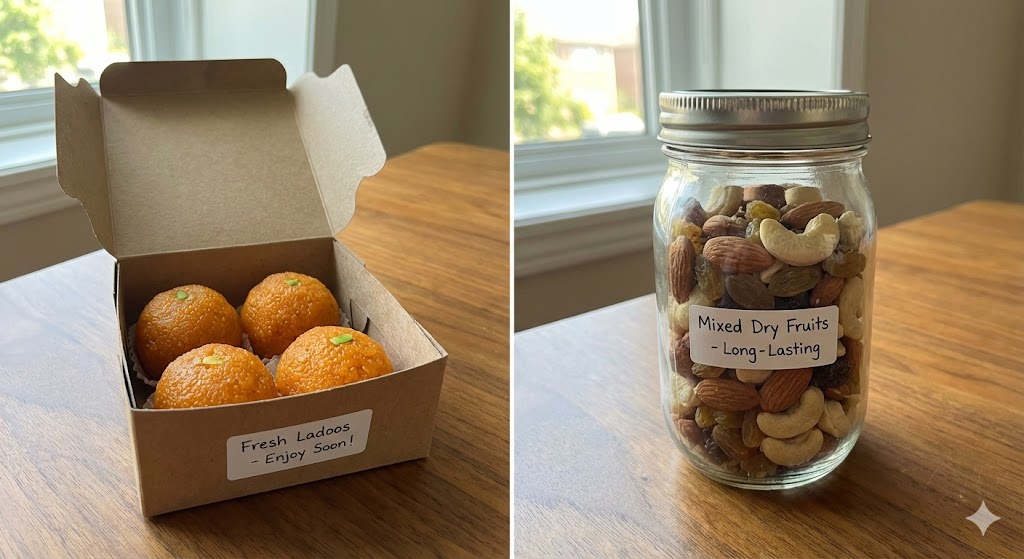
The halwai had made them on Saturday morning—nearly 48 hours before some guests opened theirs. Summer heat in UP did the rest.
Meena was mortified. I was mortified. And we both learned an expensive lesson about sweets as return gifts in Indian heat.
That experience sent me down a deep research rabbit hole: When are Indian sweets actually safe as return gifts? When should you switch to dry fruits? And is there a smart middle ground? Here’s everything I found.
The Core Difference Nobody Talks About
When people compare sweets vs. dry fruits for return gifts, they usually focus on:
-
Which looks more premium
-
Which guests will like more
-
Which is cheaper
But the real comparison should be about risk vs. reward:
Indian sweets:
-
High emotional value (traditional, comforting, universally loved)
-
High perishability risk (especially milk-based, fresh-made)
-
Weather-dependent (summer = danger zone)
-
Dietary concerns growing (diabetes, sugar-conscious guests)
Dry fruits:
-
Premium perceived value (almonds, cashews = prosperity symbolism)
-
Very low perishability risk (weeks to months shelf life)
-
Health-conscious guests approve
-
Higher cost per gram
The “safer” return gift isn’t automatically the one everyone loves more. It’s the one that reaches guests in perfect condition, causes no health concerns, and honors the occasion without risk.
Indian Sweets: The Real Shelf Life Numbers
Let’s start with facts most people don’t check before ordering 150 gift boxes of barfi.
FSSAI-approved shelf life for common Indian sweets:
| Sweet | Room Temp (20–25°C) | Refrigerated |
|---|---|---|
| Gulab Jamun | 3–5 days | 2–3 weeks |
| Rasgulla | 3–5 days | 2–3 weeks |
| Ladoo (besan/boondi) | 7–10 days | 3–4 weeks |
| Barfi (milk-based) | 5–7 days | 2–3 weeks |
| Halwa | 5–8 days | 2–3 weeks |
| Kaju Katli | 10–14 days | 3–4 weeks |
| Jalebi | 2–3 days | 1–2 weeks |
| Mysore Pak | 14–21 days | 3–4 weeks |
| Soan Papdi | 30–45 days (packaged) | Not needed |
| Til Ladoo | 20–30 days | 6 weeks |
The problem: Guests don’t eat return gifts immediately. They take them home, put them on the kitchen counter, and open them when they feel like it—2 days, 4 days, a week later.
Summer reality: Room temperature in UP, Delhi, and most of North India in May-June easily hits 35–42°C. Those “room temperature” shelf lives above? Cut them in half in peak summer.
The “Safe Sweets” Category (If You Must Give Sweets)
Not all sweets are equal risk. Here’s how to choose smart if sweets are important to you:
Lowest Risk (Safe Even in Summer)
Soan Papdi (packaged): 30–45 day shelf life in sealed box. India’s most resilient sweet. Branded versions (Haldiram’s etc.) have even longer life.
Gajak (winter months only): Sesame-jaggery base, dry, crispy, long shelf.
Chikki: Peanut/nut + jaggery brittle. Lasts months in dry conditions.
Til Ladoo: Sesame + jaggery, 20–30 days.
Dry Fruit Ladoo: Dates + nuts, no moisture, 3–4 weeks.
Medium Risk (Fine in Cool Weather, Risky in Summer)
Besan Ladoo: 7–10 days room temp. Acceptable for October–February events.
Kaju Katli: 10–14 days, reasonably safe if events are within the week.
Mysore Pak: 14–21 days when properly made and stored.
High Risk (Avoid as Return Gifts)
Milk-based sweets (rasgulla, gulab jamun, kheer-based): 3–5 days. Completely unsuitable as return gifts unless given fresh and consumed same day.
Fresh barfi (from local halwai without preservatives): 5–7 days maximum.
Halwa: 5–8 days. Looks amazing, travels badly.
Jalebi: 2–3 days at most. Never, ever as a return gift unless it’s a same-day food counter at the event.
Dry Fruits: Why They Win on Safety
Shelf life comparison is brutal in favor of dry fruits:
-
Almonds: 6–12 months stored properly
-
Cashews: 6 months at room temp, 1 year refrigerated
-
Raisins: 6–12 months sealed
-
Pistachios: 3–6 months
-
Walnuts: 3–6 months
-
Mixed dry fruit boxes (sealed): 3–6 months
What this means practically: You can buy dry fruit return gifts 2 weeks before your event, store them comfortably, and every single guest who receives one at 11 PM after a long function can take it home, put it in their cupboard, and enjoy it 3 weeks later with zero risk.
That is a logistical superpower.
My cousin who manages events professionally told me: “The moment a function host says ‘dry fruits,’ I relax completely. No cold storage, no same-day delivery, no spoilage worry. Done.”
The Prosperity Symbolism (Dry Fruits Win Here Too)
This surprised me when I researched it. Dry fruits aren’t just a practical choice—they carry genuine cultural weight in Indian tradition:
Historical context: Before refrigeration, before sugar factories, dry fruits were precious and expensive. Gifting almonds and cashews said, “I’m giving you something valuable.” That meaning embedded itself in the culture and stayed.
Traditional association:
-
Almonds: Health, intelligence, long life
-
Cashews: Prosperity, Lakshmi’s favorite nut
-
Pistachios: Celebration, festivity
-
Raisins: Sweet life, abundance
-
Walnuts: Brain health, wisdom
Puja use: Dry fruits appear on puja thalis for exactly this reason—they’re considered auspicious offerings, not just food.
Modern health angle: Nearly 11.1% of Indians now have diabetes. Increasingly, health-conscious guests silently appreciate dry fruits over sweets. Your fit, diet-conscious guests—and there are more of them every year—will genuinely prefer almonds to ladoos.
Real 2026 Pricing Comparison
Indian Sweets (Per Guest)
Local halwai options:
-
Soan papdi box (100g): ₹25–35
-
Kaju katli (100g): ₹45–65
-
Besan ladoo box (3 pieces): ₹30–45
-
Assorted sweet box (200g): ₹60–90
Branded packaged:
-
Haldiram’s soan papdi (250g): ₹85–100
-
Bikaji mixed sweets box: ₹70–120
Dry Fruits (Per Guest)
Basic options:
-
Small mixed bag (20g): ₹25–35
-
Badam (almonds, 20g): ₹30–40
-
Mixed nuts (cashew + almond, 25g): ₹45–60
Decorative boxes (wholesale Delhi IndiaMART):
-
Filled dry fruit gift box (small): ₹180–220
-
2-compartment box (100g total): ₹120–160
-
Jute pouch with mixed nuts (30g): ₹65–85
The Real Cost Gap
| Option | Per Guest | 100 Guests | Shelf Life |
|---|---|---|---|
| Local halwai ladoos | ₹35 | ₹3,500 | 7–10 days |
| Branded soan papdi | ₹85 | ₹8,500 | 30–45 days |
| Basic dry fruit bag | ₹50 | ₹5,000 | 3–6 months |
| Decorative dry fruit box | ₹180 | ₹18,000 | 3–6 months |
Insight: Basic dry fruits (₹50) cost more than basic sweets (₹35) but dramatically less than branded sweets (₹85)—while offering far better shelf life and health perception.
The Hybrid Option: Best of Both Worlds
Many event planners and hosts in 2026 are using what I call the “sweets + shagun + dry fruit” combination:
Classic hybrid packet:
• 2 pieces kaju katli (safe, 10-day shelf life): ₹20

• Small dry fruit portion (10g almonds): ₹15

• ₹11 shagun coin: ₹9

• Packaging: ₹5

TOTAL: ₹49
Why this works:
-
Sweet satisfies tradition and emotional expectation
-
Dry fruit gives health signal and practical value
-
Shagun completes the blessing
-
₹49 total is budget-friendly
Gifting blogs note that sweets combined with dry fruits as return gifts offer both “traditional roots and health-forward thinking”.
Event-Type Decision Guide
Large Wedding (200+ Guests)
Choose: Dry fruits or sealed branded sweets only.
Why: You cannot control when 200 guests open their gifts. Local halwai sweets are too risky at this scale. One spoilage complaint becomes 10.
Best pick: Sealed mixed nut pouches (₹50–70 each).
Small House Puja (20–30 Guests)
Choose: Fresh local sweets, distributed same day.
Why: Small group = you control timing. Fresh sweets from trusted halwai work perfectly when consumed within 24–48 hours.
Best pick: 2 pieces kaju katli + 2 pieces besan ladoo + ₹21 shagun = ₹55.
Navratri/Diwali Gifting
Choose: Dry fruits + mithai combo.
Why: Festival season = visits span over weeks. Guests need things that last. Also, dry fruits are traditional Diwali fare.
Best pick: 20g dry fruit mix + 1 soan papdi box = ₹55.
Housewarming (50–80 Guests)
Choose: Dry fruits in decorative box.
Why: Housewarming guests include colleagues and acquaintances who might not eat sweets for health reasons. Dry fruits feel premium and versatile.
Best pick: Small decorative dry fruit box (₹120–150 each).
Kids’ Birthday (20–40 Kids)
Choose: Sweets (specifically chikki/soan papdi) or skip entirely for stationery.
Why: Kids eat sweets on the spot. Parents of diabetic or allergic kids worry about anything edible. For safety, sweets + stationery kit is better.
Weather-Based Decision (Critical in India)
This is the factor most people forget completely:
| Month/Season | Safe Sweet Choice | Avoid |
|---|---|---|
| Oct–Feb (cool) | Any sealed sweet, ladoos, barfi | Fresh gulab jamun |
| Mar–Apr (mild) | Kaju katli, soan papdi only | Milk-based sweets |
| May–Jun (peak summer) | Dry fruits only or sealed packaged | Everything fresh, all milk-based |
| Jul–Sep (monsoon) | Dry, sealed sweets only | Anything moisture-sensitive |
The UP/Delhi reality: Dadri summers regularly cross 42–45°C. In May/June functions, only dry fruits or sealed branded sweets with proper cold packing make sense. Local halwai sweets in paper boxes are genuinely dangerous at these temperatures.
Practical Tips From Real Event Experience
Tip 1: Check manufacturing date on branded sweets
Many retailers stock old inventory. A soan papdi made 25 days ago with 45-day shelf life has only 20 days left. Always check.
Tip 2: Ask your halwai for production timing
Good halwais will tell you honestly: “These were made this morning.” Bad ones won’t. Order fresh same-day only when possible.
Tip 3: Keep dry fruit gifts in cool area before distribution
Even with long shelf life, direct sun and 45°C can degrade nuts. Store in shade or AC room before distribution.
Tip 4: For large events, mix safe categories
Half guests get dry fruits, half get sealed sweets. Reduces per-item cost while managing variety.
Tip 5: Branded over local for events over 75 guests
Haldiram’s, Bikaji, Bikanerwala—their manufacturing standards and shelf life claims are regulated and reliable. Local halwai quality varies.
The Honest Verdict
After my motichoor ladoo disaster with Meena, I developed a simple rule I now share with everyone:
“Can you be sure every guest opens this within 48 hours?”
If yes: Fresh local sweets are fine and honestly the most emotionally resonant choice.
If no (which is true for 90% of events where guests travel home after): Choose dry fruits, long-life sealed sweets (soan papdi, chikki, kaju katli from branded sources), or the hybrid combo.
Sweets are never “wrong.” They’re tradition. They’re emotion. They’re home. But a sweet that spoils in someone’s bag on a summer evening does more damage to your memory than no sweet at all.
That ₹38 ladoo that made three guests sick cost Meena far more in embarrassment and worry than the ₹5 per guest difference between local sweets and branded soan papdi would have.
Safe gifting is smart gifting. Your guests deserve both the blessing and the certainty that what you’ve given them is perfectly fine.
What’s your go-to return gift for summer events—dry fruits, branded sweets, or something else? Share your approach below—especially if you’ve found regional combinations that work brilliantly!
Pingback: How to Decline a Return Gift: Indian Etiquette Guide (2026)