Two years ago I found myself in the middle of a quiet disagreement between two people I respect equally.
My mother—traditional, deeply rooted in UP values, has hosted approximately 400 functions in her lifetime—said: “Return gifts are necessary. You cannot let guests leave empty-handed. It’s basic respect.”
My sister-in-law—practical, budget-conscious, runs a household on a single income with two school-age kids—said: “It’s become a compulsion nobody actually enjoys. People throw away half these things. Why are we spending money on plastic stationery kits nobody needs?”
Both of them were right. Completely, simultaneously right. And that’s exactly why this question—are return gifts actually necessary?—is harder to answer than it looks.
The honest answer is: it depends entirely on which occasion you’re hosting, who your guests are, what relationship you have with them, and whether the impulse to give comes from genuine gratitude or from social anxiety about being judged.
Let me break it down occasion by occasion, clearly and without hedging.
The Foundation: Two Different Types of “Necessary”
Before categorizing occasions, understand that “necessary” means two very different things in Indian social life:
Culturally/spiritually necessary: The occasion has a tradition—centuries old, rooted in religious texts or community practice—that makes return gifts part of the ritual itself. Skipping them feels incomplete in the same way skipping the aarti at a puja would feel incomplete. The return gift isn’t optional here; it’s structurally part of the occasion.
Socially necessary: The occasion has no deep traditional requirement for return gifts, but modern social norms in your specific circle have created an expectation. Skipping doesn’t violate tradition—it risks judgment. This is pressure, not obligation.
Distinguishing between these two types changes everything. One demands a response. The other invites a conscious choice.
Category 1: Occasions Where Return Gifts Are Genuinely Non-Negotiable
These are the situations where Indian cultural and spiritual tradition—not modern social pressure—creates a real expectation.
Weddings and Engagements
The return gift tradition at Indian weddings predates every modern hamper, customized mug, and branded sweet box by centuries. Ancient practice: guests received dhoti (men) or saree + Thamboolam (women) when they departed. The modern version—dry fruits, brass diyas, steel katoris, shagun coins—is just updated packaging for the same ritual exchange.
Why it’s non-negotiable: Wedding guests travel, dress up, bring shagun, offer blessings, give their time. The return gift completes the circle—their blessing received, your gratitude returned. Skipping it at a full-scale Indian wedding doesn’t just look careless. It communicates that you didn’t think your guests’ effort deserved acknowledgment.
Budget concern? The solution isn’t skipping—it’s simplifying. A ₹45 brass diya in a ₹20 jute potli with a handwritten tag is a complete, dignified return gift. A ₹500 hamper that required three sourcing meetings is not inherently better.
Rule: For any wedding or engagement where guests have been formally invited, return gifts are necessary. Always.
Religious Pujas at Home (Satyanarayan, Navratri, Diwali Puja, etc.)
This is the category where the return gift blurs most completely into prasad—and where the “non-negotiable” argument is strongest.
When guests attend a puja in your home, they come to pray alongside your family, offer blessings at a sacred moment, and participate in a divine ritual. The return gift in this context isn’t a party favor. It’s a share of the blessing—something taken from the puja’s sacred atmosphere and sent home with the guest so the grace extends beyond your walls.
Puja return gifts across traditions:
-
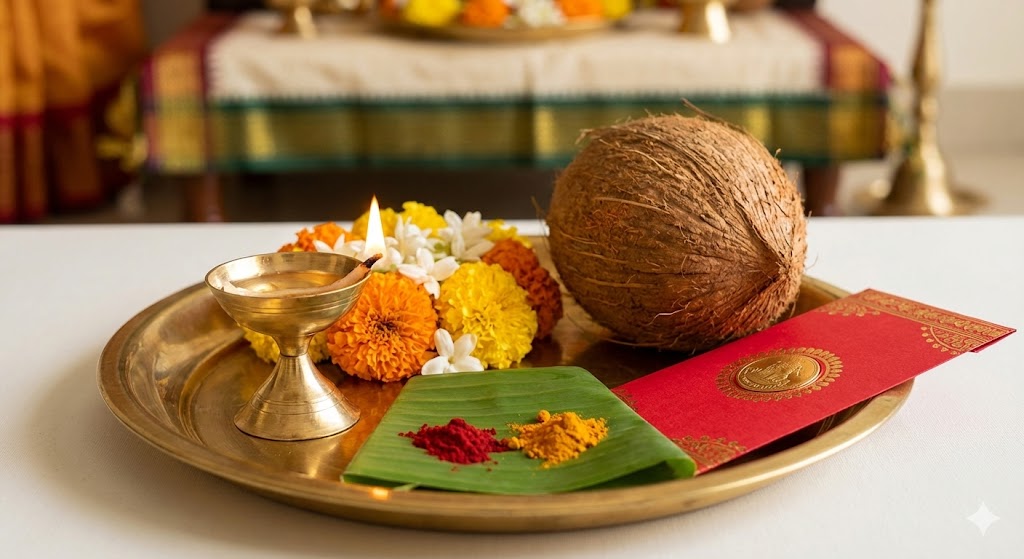
North India: Kumkum dabbi + coconut + sweets + ₹11 shagun
-
South India: Full Thamboolam (betel leaves + turmeric + kumkum + coin)
-
Maharashtra: Kumkum-haldi set + coconut + modak
-
Bengal: Mishti + paan + ₹5 coin
The famous puja blogger and etiquette resource Threadvibeliving states directly: “Getting a return gift after puja is a must in Indian homes. It is seen as a token of thanks for being a part of a divine ceremony”.
Rule: For any formal puja where guests came specifically to bless your occasion, some form of return gift is necessary. Even prasad + shagun coin qualifies completely.
Housewarming (Griha Pravesh)
Griha Pravesh carries the same spiritual weight as a wedding in Indian tradition—it’s a threshold ritual marking a new beginning, performed in front of witnesses who bless the new space. Those witnesses deserve acknowledgment.
The return gift here has a specific additional meaning: guests helped fill your new home with positive energy through their presence and prayers. Sending them home with a small token—diya, copper katori, small plant, prasad—symbolizes sharing that positive energy beyond your walls.
Rule: For a traditional Griha Pravesh with puja and invited guests, return gifts are expected and appropriate.
Baby Showers, Naming Ceremonies, Thread Ceremonies
These samskaras (sacred rites of passage) sit in the same category as weddings and housewarmings—guests come primarily to bless a significant life transition. The return gift carries those blessings back into the world.
The scale can be minimal (kumkum box + dry fruits + ₹11 coin = ₹45 total) but the gesture itself shouldn’t be skipped at any formal samskara celebration with invited guests.
Rule: Religious and life-milestone rituals where guests came to bless you = return gifts necessary, however simple.
Category 2: Occasions Where Return Gifts Are Genuinely Optional
These occasions carry no deep traditional mandate for return gifts. The expectation that exists is social—valuable to understand, but not obligatory to comply with.
Birthday Parties (Children and Adults)
As covered in our dedicated article, birthday return gifts became an Indian norm through 2000s-era social competition and Western party culture influence—not through any cultural tradition.
The official position across Indian etiquette resources: Birthday return gifts are optional.
When they make genuine sense:
-
Your child’s class-circuit party where every other party gives them (skipping creates social friction for your child specifically)
-
Milestone birthdays (1st, 10th, 25th, 50th) where the occasion feels ceremonial
-
When you have budget and genuinely want to express gratitude—not when you’re afraid of judgment
When skipping is completely valid:
-
Intimate family birthday (15 close relatives who love your child unconditionally)
-
When budget is genuinely tight—a good party experience is more valuable than cheap return gifts
-
Adult birthday parties where sophisticated guests don’t expect party favors
-
When you can substitute a meaningful alternative (group photo, experience, homemade sweet)
Rule: Birthday parties = optional. Let genuine gratitude and budget drive the decision. Never let fear of WhatsApp group judgment be the deciding factor.
Anniversary Celebrations
Return gifts at anniversary parties are “appreciated but not mandatory”—direct quote from Indian gifting etiquette sources.
The occasion is celebratory but doesn’t carry the spiritual weight of a puja or samskara. Guests come for joy, not to bless a sacred transition. The host’s investment in the celebration itself (venue, food, music) already communicates gratitude.
When to give: Silver (25th) or golden (50th) anniversaries that feel ceremonial, where guests traveled or made significant effort. The milestone nature elevates the expectation.
When to skip: Informal anniversary get-together with close family and friends. Everyone there knows each other. The relationship exists independent of a return gift.
Rule: Anniversary return gifts = optional. Milestone anniversaries benefit from them; informal gatherings don’t require them.
Farewell Parties and Retirement Celebrations
These are entirely modern occasions with no traditional return gift mandate. Think about what actually matters in these contexts: the emotional experience of being celebrated, the speeches, the shared memories. A return gift bag is pleasant but genuinely peripheral.
Rule: Skip confidently. If you want to do something, a simple sweet box + handwritten note from the guest of honor is more meaningful than any purchased gift.
Office Celebrations and Corporate Events
Corporate gifting operates on entirely different logic—budget approval processes, HR policies, vendor contracts. At internal office celebrations (team birthdays, project completions, casual Friday events), return gifts are not expected at all.
Rule: Not necessary. If you want to acknowledge attendance, a simple sweet box or branded item is sufficient and appropriate.
The Five Questions That Settle It Every Time
When you’re unsure whether your specific occasion needs return gifts, answer these five questions honestly. The answers will tell you everything:
Question 1: Did guests come to bless a sacred moment?
Yes (puja, wedding, samskara) → Return gift necessary.
No (birthday party, office event) → Optional.
Question 2: Did guests make significant effort to be there?
Traveled, took leave, dressed formally, brought their own gift → Return gift strongly appropriate.
Dropped by a neighbor’s casual birthday → Optional.
Question 3: What is your actual budget?
You have comfortable budget → Give thoughtfully.
Budget is genuinely tight → Simple prasad + shagun coin = complete and dignified.
Budget is zero → Handwritten thank-you note is better than no acknowledgment. Skip the gift, not the gratitude.
Question 4: What is your social circle’s genuine norm?
Every function in your circle gives return gifts → Skipping creates real friction. Factor that in honestly.
Your circle is more relaxed about this → You have more freedom.
Question 5: What is your motivation?
Genuine gratitude for guests’ presence and blessing → Give.
Pure fear of judgment → Pause. Fear-driven gifting creates resentment and waste.
The “Simple is Complete” Principle
One of the most damaging myths in Indian return gifting is that a small or simple gift is somehow insufficient—that you need to spend ₹150+ per guest to show proper respect.
This is completely wrong, and traditional practice proves it.
The most traditionally correct return gifts in India are among the cheapest:
₹1 coin + betel leaves + turmeric-kumkum:  ₹12 (South Indian Thamboolam)

Kumkum dabbi + ₹11 shagun:                 ₹22 (North Indian puja)

Prasad (halwa) + ₹11 envelope:             ₹28 (Universal puja)

Fresh coconut half + kumkum:               ₹30 (Maharashtra/South)
These are not budget compromises. These are the original forms of Indian return gifting—unchanged for centuries, spiritually complete, universally understood.
The ₹200 hamper with a customized mug and branded chocolates is a modern addition that carries no more traditional weight than a ₹28 prasad packet. Often it carries less, because it lacks the spiritual intentionality of the traditional items.
Rule: When budget is tight, go simple and traditional. Don’t skip; simplify. A ₹25 brass diya in a ₹15 jute bag with a handwritten note is a complete, dignified, spiritually appropriate return gift for almost any occasion.
When to Absolutely Not Give Return Gifts
This side of the question is rarely discussed but equally important.
Grief occasions (funerals, shraddh, condolence visits): Return gifts are completely inappropriate at occasions of mourning. Guests come to offer condolences—the exchange is entirely one-directional. Food offered to visitors (tea, light snacks) is appropriate hospitality. Packaged return gifts are not.
Casual drop-in visits: A friend who “came by” your home informally—not for a function—does not require a return gift. This is daily social life, not an occasion.
When budget genuinely cannot cover it: Better to give nothing than to give something so poor in quality that it embarrasses you and confuses guests. A sincere verbal thank-you with eye contact is always more dignified than a ₹15 plastic item in a flimsy bag.
When the “gift” will clearly be thrown away: Mass-produced items that guests visibly don’t want—the third identical steel katori this month, cheap plastic toys children ignore—create landfill, not gratitude. If you can’t source something genuinely useful or meaningful, the money is better spent on better food at the function itself.
When you’re forcing it at informal gatherings: A small family dinner at home, a casual birthday lunch for 8 close friends, an informal office tea-party—these don’t require return gifts. Good food, good company, and warm hospitality are already the gift.
The Cost-Decision Matrix
A simple reference for hosts making the call:
| Occasion | Necessary? | Minimum Dignified Option | Skip Condition |
|---|---|---|---|
| Wedding/Engagement | Yes | Diya + potli + ₹11 coin (₹55) | Never |
| Griha Pravesh | Yes | Brass diya + prasad (₹45) | Never |
| Religious puja | Yes | Kumkum + sweets + ₹11 (₹28) | Never |
| Baby shower/samskara | Yes | Kumkum box + badam (₹45) | Never |
| Child’s birthday | Optional | Stationery kit (₹75) | Intimate family only |
| Adult birthday | Optional | Sweets + shagun (₹35) | Casual gatherings |
| Anniversary | Optional | Depends on milestone | Informal gatherings |
| Office/corporate | Not needed | Sweet box (₹60) | Almost always |
| Farewell/retirement | Not needed | Sweet + note | Almost always |
| Condolence visit | Never | — | Always skip |
My mother and my sister-in-law were both right, but about different things.
My mother was right that at pujas, weddings, and sacred occasions, you cannot let guests leave empty-handed. It violates something older and deeper than social etiquette—it violates the sacred contract of Indian hospitality that has its roots in the Taittiriya Upanishad itself. “Atithi Devo Bhava” isn’t a nice quote for invitation cards. It’s a live instruction for how to treat every person who blesses your occasion with their presence.
My sister-in-law was right that at birthday parties and modern social gatherings, return gifts have become a compulsion driven by comparison rather than gratitude. When you’re giving return gifts to avoid judgment—not to express thanks—you’ve already lost the entire point of the tradition. You’re manufacturing a gesture rather than making one.
The line between these two realities is exactly what this article is about. Cross it consciously, not by default.
Give when the occasion is sacred and the guests came to bless you.
Give when you genuinely want to express gratitude and can do it well.
Simplify when budget is tight—but don’t skip at occasions where tradition genuinely requires the gesture.
Skip confidently when the occasion is social and the motivation is fear, not gratitude.
That’s the complete answer. Two thousand years of Indian hospitality wisdom and contemporary practical reality both pointing at the same place: the intention behind the gift matters more than whether you gave one at all.
What’s your personal approach—do you give return gifts at every occasion or have you started drawing lines? Share in the comments—this is one of the most honest conversations in Indian hosting culture right now!
Pingback: The Psychology of Return Gifts: Breaking the Escalation Trap - RGI