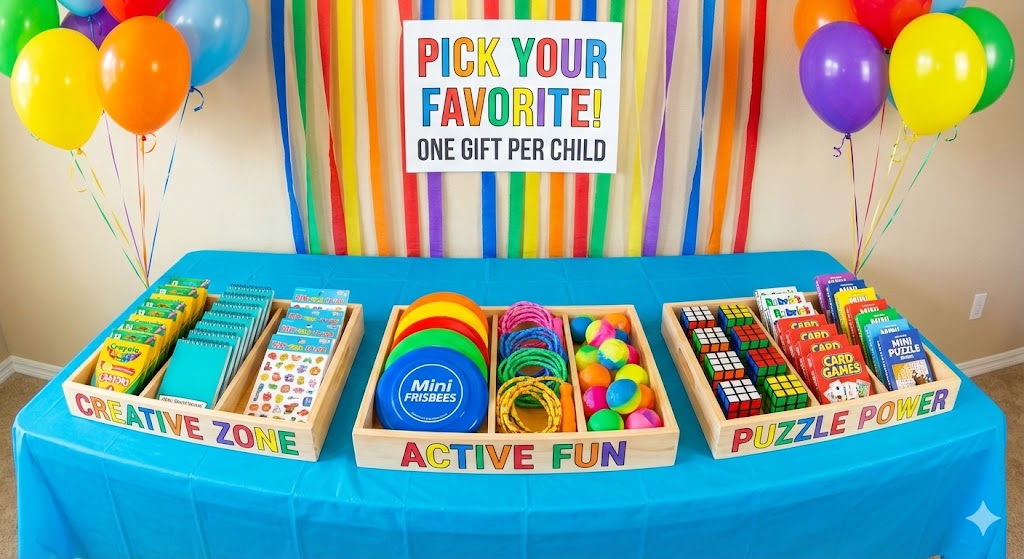
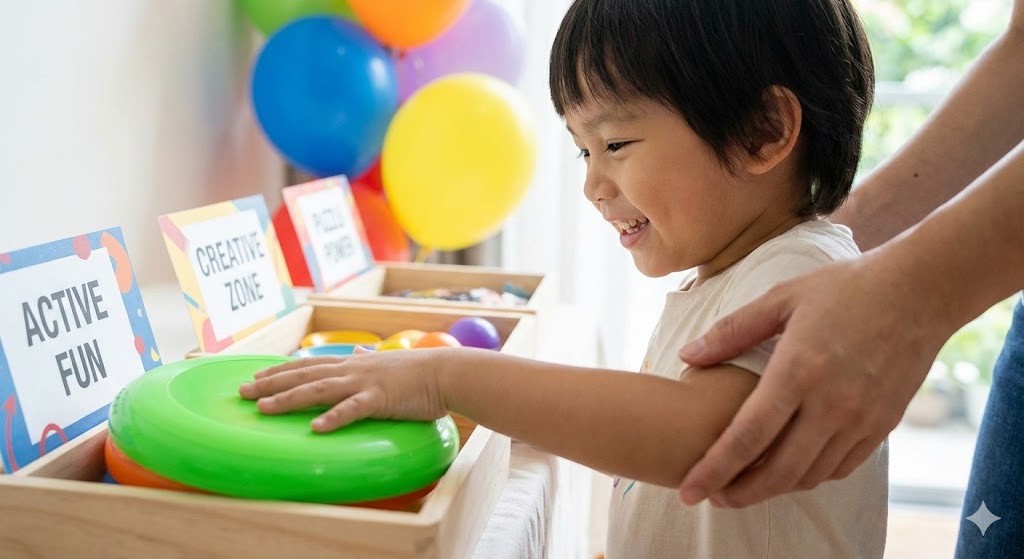
Last weekend, my friend’s daughter turned 7. Instead of handing out identical return gifts to 25 kids, she set up a “gift station” at the party entrance—a table covered with colorful trays, each holding 3–4 different gift options. As each child arrived, they got to pick what they wanted.
The result? Zero complaints about “I wanted the blue one” or “mine is smaller.” Kids were thrilled with their choices. Parents loved the novelty. And my friend saved money because she only bought what kids actually picked—no waste.
This “pick-your-own-gift” system is becoming popular for a reason. It solves the biggest return gift problems: boredom, jealousy, mismatched interests, and leftover inventory. Here’s exactly how to pull it off.
Why Gift Stations Work (And Pre-Packaged Gifts Don’t)
Handing out the same gift to everyone creates three problems:
-
Someone always wants what someone else got (“I wanted the car, not the doll!”).
-
Not every gift suits every kid (active kids hate books, creative kids hate balls).
-
You waste money buying gifts nobody wants.
A gift station flips this:
-
Kids feel ownership over their choice.
-
Parents see you thought about different interests.
-
You control exactly what gets taken (no surprises).
It’s especially perfect for mixed-age groups (4–10-year-olds) or larger parties (15+ kids) where you can’t personalize every gift.
Step 1: Choose Your Gift Categories (3–5 Options Max)
Don’t overwhelm kids with 20 choices. Pick 3–5 distinct categories that cover most interests.
Example Station for Ages 5–9 (₹80–120 Budget Per Child)
Option A: Creative Station (Art/Craft)
Tray with: crayons + mini coloring book, sketch pens, stickers, small watercolor set.
Option B: Active Station (Play/Outdoor)
Tray with: mini cricket ball, frisbee, jump rope, bubble wand.
Option C: Puzzle/Brain Station
Tray with: mini puzzle (20–50 pieces), card matching game, brain teaser book.
Option D: Bookish Station
Tray with: picture book, activity book, joke book, comic strip book.
Option E: Stationery Station (Always Popular)
Tray with: fancy pencil set, eraser collection, notebook + pen.
Cost per tray: ₹100–150 (you buy 4–5 of each gift type, so total cost stays predictable).
Step 2: Set Up the Physical Station
Location: Party Entrance or Exit
Entrance (My Preference):
-
Kids pick when they arrive → excited for the party.
-
You know exact numbers immediately.
-
Parents see the system upfront.
Exit (Good Backup):
-
Kids pick when leaving → last impression.
-
Less upfront chaos.
-
You can adjust based on who showed up.
Table Setup (Takes 15 Minutes)
-
Cover table with bright tablecloth or chart paper (₹50–100).
-
Label trays clearly: “Creative Corner,” “Active Zone,” “Puzzle Masters,” etc. Use big, colorful fonts.
-
One adult helper sits behind the table (you, auntie, or older cousin).
-
Gift cards/tags with child’s name go on each tray (pre-printed or handwritten).
-
Small signage: “Pick your favorite! One per child.”
Visual Layout Example
        [ENTRANCE]

|

┌─────────────────┐

│  CREATIVE ZONE  │  ACTIVE FUN    │  PUZZLE POWER

│ crayons, pens   │ balls, frisbee │ puzzles, games

│     ₹120        │     ₹110       │     ₹130

└─────────────────┘                │

│                 │

[Adult Helper Here]     │

│                 │

┌─────────────────┘                │

│ Thank you for coming!            │

└──────────────────────────────────┘
Step 3: Control Costs and Waste
The beauty of stations: you only buy what gets picked.
Pre-Party Math
-
Estimate attendance (use +10% rule from earlier article).
-
Buy 1.2x of each option (20% buffer for popular choices).
-
Total budget stays same as pre-packaged gifts.
Example for 20 kids:
-
Plan for 22 kids.
-
Buy 5–6 of each gift type across 4 trays (total 20–24 gifts).
-
Budget: ₹2,500 (₹110 average per child).
If “Creative Station” is most popular and empties first:
-
Kids naturally pick other trays.
-
You don’t buy 20 identical crayons nobody wanted.
Pro Tip: Price Balance
Make sure no tray looks dramatically cheaper than others:
-
All options should feel roughly equal in “cool factor.”
-
Don’t put ₹40 crayons next to ₹150 puzzles—optics matter.
Step 4: Age-Appropriate Station Examples
Ages 3–6 (Nursery–KG)
CREATIVE       ACTIVE         COMFY         STORY TIME

crayons+book   bubbles        soft ball     picture book

₹90          ₹85           ₹80          ₹95
Ages 7–10 (Class 1–4)
ART STUDIO     OUTDOOR FUN    BRAIN GAMES   WRITE ZONE

sketch pens    frisbee        mini puzzle   notebook+pen

₹110          ₹105         ₹115          ₹100
Ages 11–14 (Teens—Simpler Station)
DESK UPGRADE   TECH FRIEND    SELF-CARE     READ VIBES

pens+notes     phone stand    scrunchie     journal

₹120          ₹130         ₹110         ₹115
Step 5: Handle Common Problems Before They Happen
Problem 1: “I Want That One But It’s Empty!”
Solution:
-
Buy 20% extra of your most popular option.
-
Have a “Surprise Box” with 2–3 mixed leftover items.
-
Helper says: “Oh, that one’s super popular! Pick from these other cool ones, or check the Surprise Box!”
Problem 2: “He Got Something Better!”
Solution:
-
All trays look equally appealing (similar colors, packaging).
-
Helper phrases it as “choice,” not hierarchy: “Which zone looks fun to you?”
-
Pre-assign if needed: “Boys first pick from Active or Puzzle, girls from Creative or Story.”
Problem 3: Teenagers Acting Too Cool
Solution:
-
For 11+, make trays more “mature”: tech accessories, journals, desk items.
-
Let them pick quickly: “Grab what you like and go enjoy the games.”
Problem 4: Time Crunch (Large Groups)
Solution:
-
Two helpers: one manages entrance station, one manages exit station.
-
Pre-sort gifts by gender/age if you know guest list.
-
For 30+ kids, do station at exit so kids play first, pick later.
Budget Comparison: Station vs. Traditional
Traditional (20 kids):
-
Buy 22 identical gifts × ₹110 = ₹2,420
-
Risk: 4–5 kids hate theirs, 3–4 gifts unused.
Gift Station (20 kids):
-
5–6 gifts per tray × 4 trays × ₹110 avg = ₹2,640
-
Benefit: Every kid picks what they want, zero waste, higher satisfaction.
Net: ₹220 more, but zero complaints, zero leftovers, happier kids.
Party Flow With a Gift Station
3:00 PM: Guests arrive → Pick gift at entrance → Excited for party

3:30 PM: Games, cake, food

5:00 PM: Kids leave → Already have their personalized gift
No last-minute gift scramble. No “one kid left without.” Clean, smooth exit.
Pro Tips From Parents Who’ve Done It
Tip 1: Test Run
Do a trial station for 5 gifts at home. Time yourself. See what looks good on camera (parents will take photos).
Tip 2: Helper Script
Train your helper:
“Welcome! Pick your favorite zone—one gift per child. Which looks fun?”
Keep it quick, cheerful, decisive.
Tip 3: Venue Permission
For paid venues, confirm they allow a gift station. Most do, but some have rules about tables near entrances.
Tip 4: Photo Op
Gift station = great Instagram moment. Bright trays, happy kids picking—shareable content.
Tip 5: Scale for Size
-
10–15 kids: 3 trays
-
20–30 kids: 4–5 trays
-
35+ kids: Split into entrance + exit stations
When Gift Stations DON’T Work
Skip this if:
-
Very young kids (under 4)—too indecisive, need adult help for everything.
-
School distribution—teachers want identical items, no decision-making.
-
Tiny parties (under 8 kids)—not enough variety to justify setup.
-
Super tight timeline—takes 30–45 minutes to set up properly.
Stick to pre-packaged for those cases.
Final Verdict
Gift stations aren’t just cute—they solve real problems:
-
No more “I hate mine” complaints.
-
No leftover gifts nobody wanted.
-
Kids feel ownership over their choice.
-
Parents think you’re thoughtful and creative.
The first time takes effort (planning trays, buying variety). After that, it’s your signature move. Kids will ask, “Are we doing the gift station again?”
Next time someone asks, “What did you give as return gifts?”, you get to say: “We let them pick. It was amazing.”
Have you tried gift stations? What worked or flopped? Drop your experiences below—other parents planning parties need these real stories!