My mother-in-law has a habit I’ve watched for years but only recently understood.
Whenever she receives a return gift at any function—wedding, puja, housewarming—she does something specific. She accepts it with both hands. Smiles. Says “bahut sundar hai” or “aapne bahut mehnat ki.” Then she brings it home. Even if it’s something she’ll never use. Even if she has six identical steel katoris already. Even if the sweets are a brand she doesn’t like.
I asked her once: “Chachi, why do you always accept everything? You don’t even open half of these.”
She looked at me like I’d asked something slightly foolish and said: “Beta, when someone gives from their heart, refusing is not etiquette. It’s rejection.”
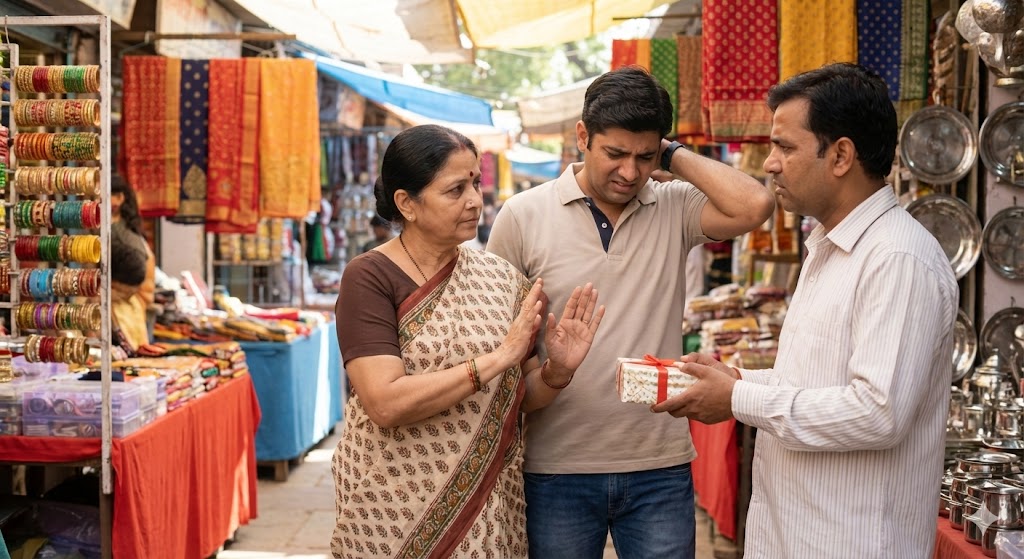
That sentence completely reframed how I think about this topic. Because here’s the truth: in Indian culture, the default position on return gifts—on almost any gift given at a ceremony—is accept graciously, always. The act of giving is an expression of relationship. Refusing it, even with perfectly polite words, communicates something the giver will feel long after the words are forgotten.
But. There are real situations where declining is not just acceptable—it’s the right and honest thing to do. The skill is knowing the difference. And knowing exactly how to decline when you must, so the relationship stays completely intact.
Why Refusing Gifts Feels So Complicated in India
In most Western cultures, declining a gift is fairly straightforward—you thank the person, explain briefly, and move on. In India, gifting is embedded in a much deeper relational framework. Understanding why makes the etiquette clearer.
Gifts are relationships, not objects: When an Indian host hands you a return gift, they’re not just giving you a box of sweets. They’re completing a circle—you honored their occasion with your presence, they’re honoring you back. Refusing that circle feels, at a subconscious level, like refusing the relationship.
Prasad cannot be refused: If the return gift is prasad—food or items blessed during a religious ceremony—refusing is considered spiritually inappropriate in Hindu tradition. Prasad is understood as God’s blessing being passed through the host’s hands. You accept it. Always.
The “token protest” tradition: In Indian social culture, it’s actually polite to protest slightly before accepting a gift—”Arre, kya zaroorat thi?” or “Aap log itna kyun kiya?”—while still accepting it. This mild resistance signals that you’re not greedy, not expectant. It’s a social ritual, not genuine refusal. Guests and hosts both understand this dance.
What this means practically: Most situations that feel like “I want to refuse this return gift” are actually situations where the Indian-appropriate response is gracious acceptance + private decision about what to do with it later. Accept it warmly. Re-gift it if it doesn’t suit you. Donate it. Repurpose it. But at the ceremony, in front of the host—accept.
When Declining IS Appropriate (The Real Exceptions)
With that cultural foundation established, there are genuine situations where declining is correct, ethical, or necessary. These are specific and limited.
Situation 1: Professional or Corporate Settings
This is the clearest case. Many organizations—government offices, corporates, NGOs, educational institutions—have explicit policies about employees accepting gifts from external parties.
Example: You’re a school teacher. A student’s parent hosts a function and wants to give you a return gift. You’re in a government school with a no-gifts policy.
How to decline correctly:
-
Accept the gesture warmly with both hands first
-
Explain quietly, not publicly: “Aap bahut achhe hain. Unfortunately hamare school mein yeh policy hai—main gifts accept nahi kar sakta. But aapka thought bahut bada hai.”
-
If they insist, suggest: “Aap prasad mujhe de dijiye—woh main zaroor lunga.”
The principle: Explain the constraint, not the unwillingness. You want to accept. A rule prevents you. That is a completely different message from “I don’t want this”.
Situation 2: Health or Allergy Concerns (Edible Return Gifts)
Return gifts are frequently food-based—sweets, dry fruits, chocolates. A diabetic guest. Someone with severe nut allergy. Someone on a religious fast during which specific items can’t be consumed.
The mistake most people make: Refusing the entire return gift packet.
The correct approach: Accept the packet. Explain if necessary. Redistribute later.
If you’re diabetic and the host is a close friend:
“Bahut sundar packaging hai! Mujhe diabetes hai toh yeh sweets main khud nahi kha sakta—but main ghar le jaunga aur bacchon ko dunga. Aapka gesture bahut meaningful hai.”
If you have a nut allergy and the gift is a dry fruit box:
Accept it at the function. At home, give it to someone who can consume it safely. The host does not need to know this at the venue.
When to mention it at the function: Only if the host is someone you know very well and the information would genuinely help them (e.g., they plan to send the same gift to your home later). Otherwise—accept now, redistribute privately.
Situation 3: The Gift Is Culturally or Spiritually Inappropriate
This is rare but real. Certain gifts carry inauspicious connotations in Hindu tradition that make accepting them uncomfortable—or in very traditional families, genuinely problematic.
Items considered inauspicious as gifts in Hindu tradition:
-
Sharp objects (knives, scissors) — symbolizes severing relationships
-
Handkerchiefs alone — associated with grief and sorrow
-
Empty wallets/purses — symbolizes poverty and lack
-
Sindoor or mangalsutra given to a married woman — deeply inappropriate, implies widowhood
-
Black items at auspicious ceremonies — inauspicious color for weddings, pujas
How to handle:
If someone gifts you something from this list at a religious ceremony and you’re from a traditional family, you can:
-
Accept it quietly and choose not to use it
-
Ask an elder privately what the appropriate response is
-
In very rare cases where it creates genuine distress: accept, take it home, then discuss with the giver privately later
Never: Make a scene at the event. Never announce publicly that a gift is inauspicious. The embarrassment caused does more relational damage than the item itself.
Situation 4: You Are the Organizer’s Close Family (And You Genuinely Don’t Need It)
At large Indian weddings and functions, the immediate family of the hosts—the bride’s parents’ siblings, the groom’s immediate cousins—sometimes receives return gifts alongside guests. In some families this feels unnecessary since they were co-organizers, not guests in the traditional sense.
If you want to graciously decline as a family member:
“Bhabi, please yeh baaki guests ko dedo—main toh family hoon, mujhe zaroorat nahi. Aapka shukriya.” (Sister-in-law, please give this to other guests—I’m family, I don’t need it. Thank you.)
Important condition: This only works within genuinely close family. Saying this to an acquaintance or distant relative comes across as socially odd. And only say it privately, to the host personally, never at the gift table in front of other guests.
Situation 5: The Gift Is Disproportionately Expensive (And Creates Obligation)
This is the most psychologically complex situation. Someone gives you a return gift that is clearly far more expensive than the occasion warrants—a silver set at a small birthday party, jewelry at a housewarming. In Indian culture, an excessively expensive gift can create a sense of reciprocal obligation that feels uncomfortable, especially in professional relationships or with people you’re not close to.
The honest truth: You still accept it. In Indian social culture, refusing an expensive gift from someone who gave it sincerely is more damaging to the relationship than the obligation created by accepting.
What you do instead:
-
Accept graciously
-
Send a genuine, personal thank-you note within 48 hours
-
Return the generosity appropriately when the opportunity arises—their next function, their child’s birthday, their Diwali
This is the Indian way of managing this situation. Not refusal. Reciprocity.
The Token Protest (What’s Normal vs. What’s Rude)
Understanding this distinction prevents a lot of social confusion.
Normal Indian social behavior:
Guest picks up return gift packet

Guest: "Arre, kya zaroorat thi?"

Host: "Kuch nahi hain, lele please"

Guest: "Bahut zyada ho gaya aapne"

Host: "Nahi nahi, le lo"

Guest: Accepts with smile
This entire exchange, word for word, happens at 80% of Indian functions. It is not a genuine attempt to decline. It is social lubrication—the guest signals they’re not greedy, the host signals they gave willingly. Both parties know this. Both are satisfied. This is NOT declining. This is accepting correctly.
What IS rude:
-
Leaving the gift on the table and walking away
-
Saying “no thank you” in English flatly with no explanation (feels cold, dismissive)
-
Making the host feel their gift was inadequate (“nahi chahiye, chhota hai”)
-
Refusing publicly at the gift table in front of other guests
-
Refusing prasad in a religious setting under any non-emergency circumstance
How to Decline Graciously: Exact Phrases That Work
When you genuinely must decline, the language matters enormously. These are phrases that communicate the right thing:
For professional/policy situations (formal):
“I’m deeply touched by this gesture. Unfortunately, our organization’s policy doesn’t allow me to accept gifts. Please know your thought means more than any item could.”
For professional situations (Hindi):
“Aapka dil bahut bada hai. Lekin hamare office mein yeh nahi chalta. Aap samajh sakte hain na? Bahut shukriya.”
For health concerns with close friends:
“Yaar, diabetes ke wajah se main kha toh nahi sakta—but main ghar le jaunga aur share karunga. Aapne jo socha, woh bilkul sahi tha.”
For close family who genuinely don’t need it:
“Didi, please yeh baaki logo ko dedo. Hum toh family hain. But aapka gesture dil ko chhu gaya.”
Universal principle in all of the above:
-
Start with genuine appreciation (never skip this)
-
Explain the constraint clearly (policy/health/family role)
-
Signal the relationship is completely fine
-
Never make it about the gift being unwanted—always about the circumstance
What to Do WITH a Return Gift You Don’t Want
Because the answer to “how to decline a return gift” is usually “accept it and then decide later,” here’s what thoughtful people do with return gifts they can’t use:
Re-gifting: Completely acceptable in Indian culture. A steel katori you already have six of becomes a perfect gift for someone setting up a new home. Just don’t re-gift it back to the same social circle where it originated.
Donating: Many return gifts—sweets, dry fruits, diyas—are perfect donations. Old age homes, children’s shelters, local temples. The gift gets a meaningful second life.
Repurposing: A diya you don’t need for decor becomes part of your Diwali setup. A brass item you have duplicates of becomes office decor. Practical repurposing is never disrespectful.
Storing: Some return gifts—especially religious items like small idols or silver coins—deserve to be kept even if never used. The intention they carry has value independent of utility.
The One Situation Where You Must Never Decline
Let me be absolutely direct about this because it matters.
Never decline prasad from a religious ceremony.
Prasad—food or items blessed during puja, Satyanarayan katha, Kanjak, temple visits—is not a gift in the social sense. It is considered God’s blessing passed through human hands. Refusing it is understood, in Hindu tradition, as refusing divine grace.
Even if you’re full. Even if you’re diabetic. Even if you’re on a fast that technically excludes this item. Accept it. Touch it to your forehead if you can’t consume it. Ask someone nearby to receive it for you. But the gesture of declining directly—especially in front of the host—creates a spiritual and social discomfort that no explanation fully resolves.
This is the one absolute in Indian return gift etiquette. Everything else has context and nuance. This doesn’t.
The Bigger Lesson: What Declining Actually Communicates
My mother-in-law was right, but let me complete her thought.
When you decline a return gift, even with perfect words and genuine reason, the giver feels—at some level—that their gesture was rejected. The gift was their closing act of the relationship exchange: “You honored us. We honor you back.” Declining disrupts that completion.
Accepting graciously—even something you’ll never use, even something that creates mild obligation, even something that goes straight into a donation box when you get home—completes the circle. The host feels their effort was valued. The relationship stays intact. And you’ve gained nothing materially while losing nothing emotionally.
That’s actually a pretty good deal.
Accept. Both hands. Smile. Say something genuine. Decide later.
That’s the Indian way. And it’s been working for a very long time.
Have you ever been in a situation where you genuinely needed to decline a return gift? How did you handle it? Share in the comments—these real scenarios are where etiquette gets genuinely interesting!
Pingback: Customized vs Ready-Made Return Gifts: Is It Worth It?