Two types of parents exist when it comes to kids’ parties.
The first type counts invites, orders exactly that many return gifts and that much food, and then spends the entire party stressed because three extra kids show up and two confirmed guests don’t come.
The second type uses a simple formula, builds a small buffer, and enjoys the party knowing they’re covered.
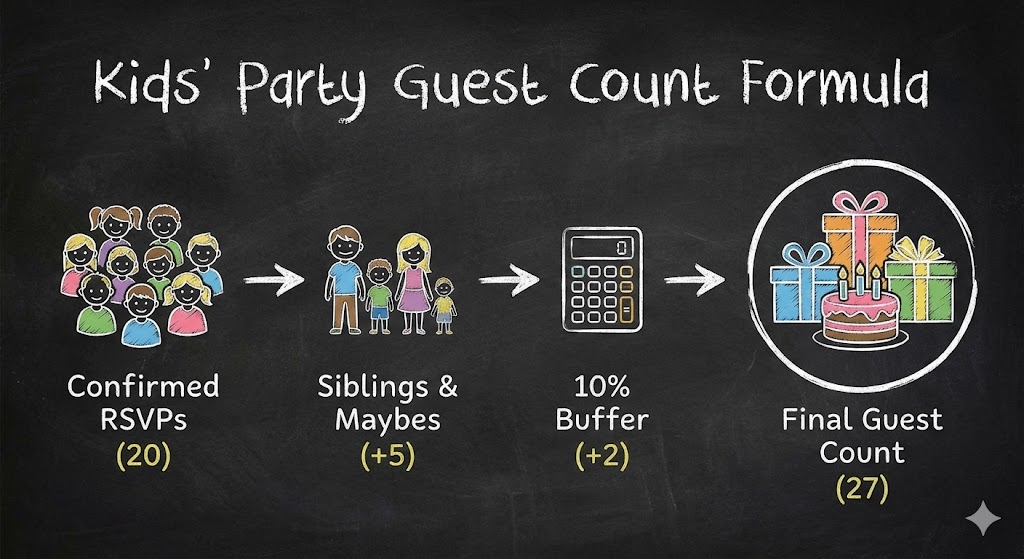
After watching both kinds in action (and making my own mistakes), I’ve realised you don’t need a fancy spreadsheet to get this right. You just need to understand how people actually behave and then apply one simple idea: the +10% rule.
Let’s go step by step, with real-world numbers you can trust.
Why “Invited = Guests” Is a Fantasy
Parents love to plan with round numbers.
“I invited 25 kids, so I’ll buy 25 gifts, order cake for 25, and we’re done.”
Then reality shows up:
-
Some parents never RSVP (common complaint in parenting forums).
-
A few kids who said yes don’t come due to sickness or last-minute issues.
-
Some who never replied suddenly appear at the party.
-
And in Indian setups, you often get siblings as surprise guests.
Looking at parent discussions and real experiences:
-
Many parents report around 40–60% attendance for whole-class invites, unless it’s a very close-knit group.
-
Others say they plan for about half the invited kids to come when they barely know the other parents.
-
Some had the opposite: “I expected 10, 21 people came” because friends and siblings showed up.
So if you simply match your planning to the invite count, you either:
-
Over-buy and waste money, or
-
Under-buy and end up short on gifts, food, or cake.
You need something smarter—but still simple enough to use every year.
Step 1: Start With Three Lists, Not One
Once invitations go out (ideally 10–14 days before the party), don’t just note “30 invites sent”. Break it into three columns:
-
Confirmed YES
-
Confirmed NO
-
No Response / Maybe
Example:
You invite the whole class + a few building friends:
-
Total invites: 30
-
Confirmed YES: 14
-
Confirmed NO: 3
-
No response / Maybe: 13
Don’t panic yet. This actually gives you a lot of information.
Step 2: Turn “No Response” Into a Realistic Number
This is where most parents miscalculate. They either:
-
Ignore no-responses and plan only for confirmed kids (risky), or
-
Assume everyone will come (expensive and wasteful).
From multiple parent discussions and real-life shares:
-
Many parents report about 30–50% of “no response” families still showing up, especially for younger kids’ parties where parents don’t take RSVPs seriously.
To stay safe but not crazy, you can use a 30% rule for no-responses:
Expected from No-Response≈No-Response Count×0.3
In our example:
-
No-response: 13
-
30% of 13 ≈ 4 kids
So now you have:
-
Confirmed YES: 14
-
Expected from no-response: 4
-
Expected Kids = 18
This is already more realistic than just “14 confirmed”.
Step 3: Add Siblings (The Silent Extra Guests)
Every parent who’s hosted a kids’ party knows this: you invite one child, they arrive with a younger or older sibling.
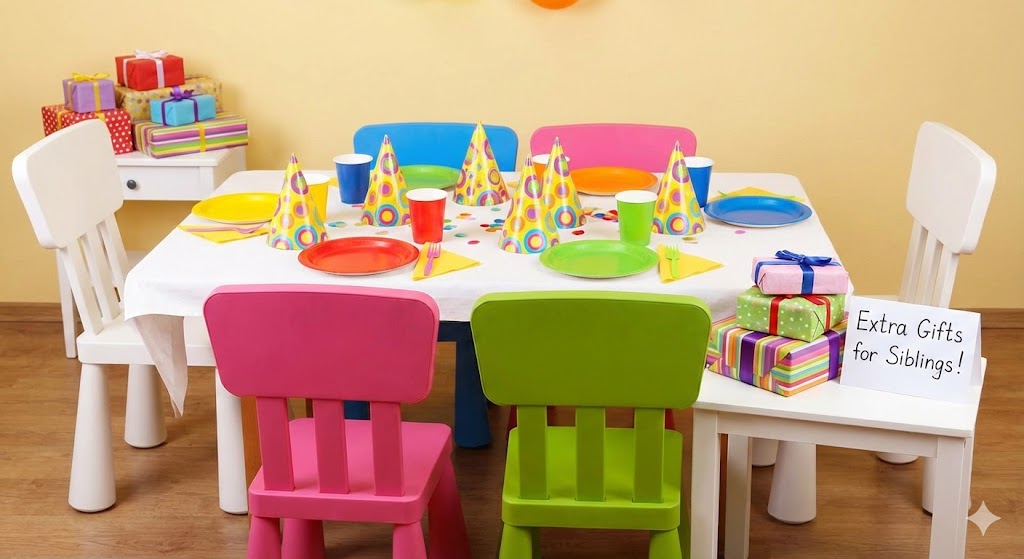
Online etiquette threads are full of people complaining that siblings pushed them over the per-head limit in paid venues. Some event hosts now plan a “plus one” buffer just for siblings.
In typical Indian/NRI context:
-
For younger age groups (Nursery–Class 2), it’s common for 20–30% of invited kids to bring siblings.
-
For older kids (Class 3+), this drops to around 10–15%.
A simple rule you can use:
Expected Siblings≈Confirmed YES×0.25
Using our example:
-
Confirmed YES: 14
-
Expected siblings: 14 × 0.25 = 3.5 ≈ 3–4 siblings
Now your count becomes:
-
Expected Kids (original invitees): 18
-
Expected Siblings: 3–4
Let’s take 3 to stay reasonable.
New working guest count: 21 kids
We’re not done yet—but you can see why “14 confirmed” is misleading.
Step 4: Apply the +10% Rule
Now comes the part that saves you from last-minute embarrassment.
Even after you factor in no-responses and siblings, you still face:
-
A kid your child insisted on inviting in person last minute
-
A neighbor who shows up even though they “weren’t sure”
-
A cousin who arrives late but still expects cake and gift
-
Counting mistakes or one parent misreading the date and landing up with their child
This is why experienced planners and even return-gift brands recommend a buffer of 5–10% on top of your calculated number.
One popular Indian return-gift calculator literally suggests:
Confirmed RSVPs + 10% Buffer = Total return gifts to buy.
I prefer using that buffer on your realistic expected count (not just confirmed RSVPs).
So:
Final Guest Count=Working Count×1.10
From our example:
-
Working Count (kids + siblings): 21
-
10% of 21 = 2.1 ≈ 2
Final Guest Count = 21 + 2 = 23 kids
So even though:
-
30 were invited
-
Only 14 clearly confirmed
You should plan for around 23 kids.
That means:
-
23 return gifts
-
Cake sized for 23 kids (plus adults)
-
Food and chairs based on 23, not 14 and not full 30
Step 5: Shortcut Formula (If You Don’t Want to Think Too Much)
If you don’t want to do all this every time, here’s a shortcut you can remember:
Take confirmed YES kids, multiply by 1.4, then multiply by 1.1.
Why?
-
×1.4 roughly covers no-response kids + siblings based on typical patterns.
-
×1.1 adds the 10% safety buffer.
So:
Final Count≈Confirmed YES×1.4×1.1
Example:
-
Confirmed YES: 15
-
15 × 1.4 = 21
-
21 × 1.1 ≈ 23
Plan for 23 kids.
You can round this up to the nearest whole number and then check if it feels reasonable based on how your circle behaves (some groups are more punctual/organized than others).
Step 6: Ready-Made Scenarios You Can Copy
Scenario A: You Invited the Whole Class (25–35 Kids)
Typical pattern from real parents:
-
30–60% actually show up, depending on how close-knit the group is.
If you invited 30 kids:
-
Expect 12–18 kids, plus some siblings.
-
Practical planning range: 18–22 kids.
-
With +10% buffer: plan for 20–24 kids.
Scenario B: Only Close Friends and Cousins (10–15 Kids)
These are people you know personally, who are more likely to show up if they say yes.
If you invited 12 kids:
-
Confirmed YES: say 9
-
No-response: 3 (you can gently follow up here)
-
Expect maybe 1–2 no-response kids to show, and 1 sibling.
-
Target: 11–12 kids
-
With +10% buffer: plan for 12–13 kids
Here you don’t need a huge buffer because social obligation is stronger in close circles.
Scenario C: Venue Charges Per Head (Soft Play, Trampoline Park, etc.)
These are tricky because extra kids cost you money.
Parents on etiquette forums say:
-
It’s rude when guests bring siblings without asking if the host is paying per head.
-
Some parents explicitly write “Due to limited space, no siblings please” on invites when it’s a per-head venue.
If you must control numbers:
-
Clearly mention on the invite: “Party is booked per child; we’ve arranged activities and gifts for X kids only.”
-
Or politely say: “Due to venue limits, this party is only for invited children (no siblings, please).”
Still, use a small buffer:
-
If booking for 15, ask venue if 2 more can be added on the day at extra charge.
-
Keep 2 extra return gifts anyway.
Step 7: How the +10% Rule Connects to Budget
Once you’ve finalised your planning number, use it everywhere:
-
Return gifts
-
Cake size
-
Snacks and drinks
-
Plates, glasses, tissues
-
Seating arrangements
Example:
You settle on 22 kids as your final count.
-
Return gifts: Buy 23–24 (one extra for safety or keepsake).
-
Cake: Order for 22 kids + 8–10 adults (most bakeries can tell you size based on total pax).
-
Food: Plan for 22 plates but buy slightly extra of flexible items (chips, juice boxes, popcorn).
This matches how return gift planners recommend using a 5–10% buffer for exactly this purpose.
Step 8: What to Do If You Still Get Surprised
Even with all this, parties are unpredictable. Here’s how to handle both extremes.
If More Kids Show Up Than Planned
-
Return gifts:
-
Have 2–3 extra “neutral” gifts (chocolate bars, small stationary kits) that don’t look very different.
-
If absolutely necessary, siblings can share one return gift if they’re from the same family—explain kindly to the parent.
-
-
Food:
-
Serve slightly smaller portions of cake.
-
Keep extra chips/namkeen and juice that can stretch.
-
If Fewer Kids Show Up
This happens too—many parents online talk about inviting 20 and only 5–8 showing up.
-
Use leftover gifts later (for Diwali, random surprises, or future birthdays).
-
Extra cake can go to neighbors, building security, domestic staff, or be sent to grandparents.
-
Don’t take it personally—every parent eventually has “that party” with fewer guests than expected.
Quick Checklist: Use This Before Finalizing Numbers
-
Total invites sent: ___
-
Confirmed YES: ___
-
Confirmed NO: ___
-
No response: ___
-
Expected from no response (30% of #4): ___
-
Expected siblings (25% of confirmed YES): ___
-
Working guest count = 2 + 5 + 6 = ___
-
+10% buffer (round up): ___
-
Final planning count: ___
Fill that once, and everything else becomes easier.
Final Thoughts
The goal isn’t to predict perfectly; it’s to avoid panic during the party.
If you plan only from your invite list, you’ll almost always be wrong. If you plan only from your confirmed list, you’ll almost always be short. When you combine real-world behavior (no-responses, siblings, last-minute shows) with a simple +10% rule, your planning suddenly feels calm and controlled.
Your child won’t remember whether there were 18 kids or 24. But you’ll definitely remember whether you were relaxed and present—or running to the shop mid-party.
Plan smart, add that 10% cushion, and then focus on enjoying the chaos. That’s what kids’ parties are really about.
Pingback: How to Calculate Your Return Gift Budget: The Perfect Formula 2026