My childhood home in Dadri had neighbors from four different communities within the same three-floor building. Ground floor: a Punjabi family from Amritsar. First floor: us—a UP Brahmin family. Second floor: a Tamil family who’d relocated for the father’s government posting. And just across the courtyard: a Muslim family from old Lucknow.
In a single year, I attended a Punjabi wedding (the Sikh ceremony was stunning, the reception gift table groaned under the weight of beautifully wrapped packets), a Tamil housewarming (the Thamboolam ritual was the most quietly sacred thing I’d witnessed as a child), our own family’s Satyanarayan katha (kumkum, coconut, prasad, a small coin for every guest), and an Eid celebration at the Muslim family’s home where everyone left with sewaiyan and a gift envelope.
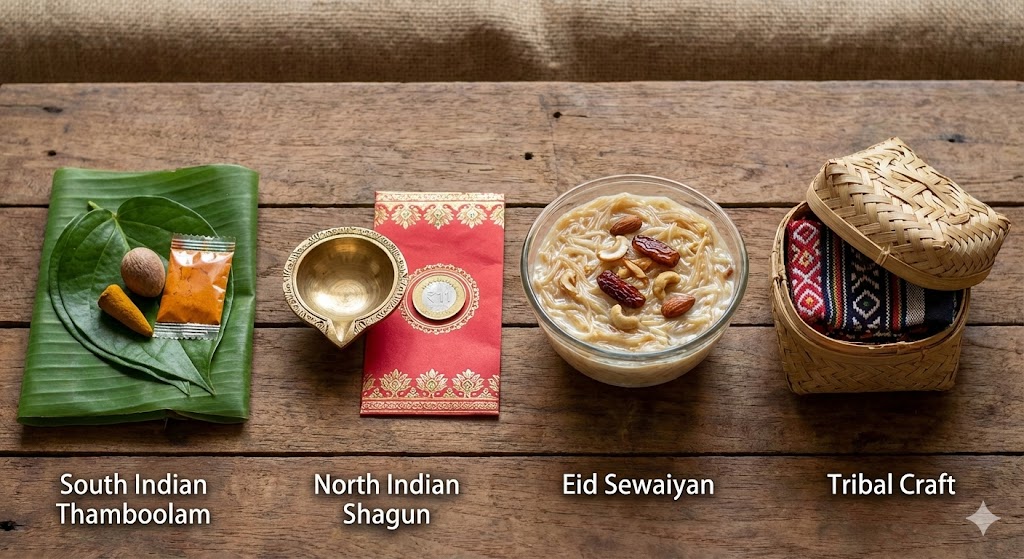
Four ceremonies. Four communities. Four completely different ways of saying the same thing: “You came. You mattered. Carry something of this occasion home with you.”
That building was my first real lesson in what makes India extraordinary—the same impulse toward generosity and hospitality runs through every tradition, but the language that impulse speaks is completely different across communities, regions, and faiths.
Understanding those differences doesn’t just make you a more sensitive guest. It makes you a more thoughtful host in an increasingly diverse social landscape.
The Common Root Beneath All Differences
Before the differences, the shared foundation.
Every return gift tradition in India—Hindu, Muslim, Sikh, Christian, Jain, tribal—traces back to one universal belief: the guest who crosses your threshold carries divine energy, and honoring them with a parting gift completes the sacred exchange of the occasion.
In Hindu tradition this is “Atithi Devo Bhava” (the guest is God).
In Islamic tradition it’s the concept of “Daawat” hospitality where generosity to guests is a religious virtue.
In Sikhism it’s “Seva” (selfless service)—guests are fed, blessed, and sent home with warmth.
In Christianity it reflects the Biblical instruction toward generosity and hospitality.
In Jainism it aligns with “Atithi Sambhav”—reverence toward the guest-soul.
Same impulse. Different expressions. That’s India’s gifting story in one line.
Hindu Traditions: The Most Regionally Diverse
Hinduism itself is not one tradition—it’s hundreds of regional practices, local deities, community customs, and family variations. Return gifting within Hindu culture reflects this diversity more than any other faith.
North India: The Grandeur of Giving
States: Uttar Pradesh, Bihar, Haryana, Delhi, Rajasthan, Madhya Pradesh
Defining character: Generous, visually abundant, socially visible. North Indian return gifts are meant to be seen—beautifully wrapped, often stacked on large decorated trays, distributed with ceremony.
Core return gift items:
-
Kumkum dabbis (small vermilion boxes)
-
Dry fruits in decorative packets
-
Sweets from known halwais
-
Shagun coins (always ₹11 or ₹21)
-
Steel or brass katoris
What makes North India unique: The social hierarchy embedded in gifting. Elders receive visibly better gifts. Priests receive the most elevated acknowledgment. The gift itself communicates the host’s respect for the relationship—which is why quality variations within the same function are expected and understood, not resented.
Regional signature:
-
Rajasthan: Block-printed potli bags, lac bangle sets, mirror-work packaging—gifts that showcase Rajasthani craft identity
-
UP/Awadh: Shagun strongly emphasized. Kumkum + badam + ₹11 coin is the classic set. Everything done quietly, without ostentation, but with complete attention to ritual correctness
-
Delhi/Punjab (overlap): Premium packaging, branded sweets from Haldiram’s or local mithai shops, brass items
South India: Ritual Precision Over Abundance
States: Tamil Nadu, Karnataka, Kerala, Andhra Pradesh, Telangana
Defining character: Ritual-precise, spiritually loaded, every item intentional. South Indian return gifting is less about visual abundance and more about symbolic completeness—each item placed in a Thamboolam packet has a specific role.
Thamboolam: The Universal South Indian Return Gift
As covered in our dedicated Thamboolam article, this is the signature South Indian return gift across all occasions:
-
Betel leaves + areca nuts (core, non-negotiable)
-
Turmeric + kumkum (cones)
-
Banana or coconut
-
₹1 coin (traditional humility)
-
Jasmine flowers
What makes South India unique: The blouse piece tradition. At South Indian weddings, women guests typically receive a silk blouse piece (fabric) alongside Thamboolam—a tradition that dates to the era when cloth was the most valuable portable gift. The blouse piece has survived modernization because it carries status: the quality of the fabric communicates the family’s regard for their guests.
Regional signatures:
-
Tamil Nadu: Kanjeevaram silk blouse piece + full Thamboolam. Bronze or brass puja items for housewarming. Temple-inspired gifts dominant
-
Kerala: Coconut-centric (sacred fruit). Spices, Ayurvedic products, brass Nilavilakku (lamps) for significant occasions
-
Karnataka: Sandalwood items, Mysore silk pieces, traditional craft items alongside Thamboolam
-
Andhra/Telangana: Kalamkari items (hand-painted fabric art), traditional sweets, stronger influence of fresh fruit in Thamboolam
Maharashtra and Gujarat: The Business of Generous Giving
Defining character: Warm, sweet-heavy, community-conscious. Maharashtra and Gujarat share a mercantile heritage where gifting is deeply tied to community relationships and business networks.
Maharashtra signature items:
-
Coconut (sacred, non-negotiable)
-
Besan ladoo or modak
-
Kumkum + haldi (always)
-
Warli art items for modern gifting
Gujarat signature items:
-
Tilgul (sesame-jaggery sweet)
-
Bandhani fabric potli bags
-
Gathiya or mathiya (savory snacks)
-
₹21 shagun (2+1 = trinity blessing)
-
Mirror work items, tribal craft pieces for premium events
What makes Gujarat unique: The community expectation. In tight-knit Gujarati communities—business families especially—return gifts are deeply tied to social reciprocity. The quality of your return gift is a direct reflection of how you value your community relationships. This isn’t vanity; it’s a centuries-old mercantile community’s language of respect.
East India: Community, Sweets, and Craftsmanship
States: West Bengal, Odisha, Assam, Jharkhand
Defining character: Community-centered, sweet-forward, craft-proud. Eastern Indian gifting traditions emphasize shared celebration over individual acknowledgment.
Bengal:
-
Mishti (sweets) are the absolute center of every occasion. Rasgulla, mishti doi, sandesh—multiple sweet varieties at once signals abundance
-
Terracotta and dokra art items for premium occasions
-
Paan + supari completes every Bengali farewell ritual
-
Community Durga Puja gifting: prasad from the puja distributed to the entire neighborhood—gifting that crosses individual relationship lines
Odisha:
-
Silver filigree work (Cuttack is the center of India’s finest silver filigree)—extremely distinctive regional gift
-
Temple art items, tribal craft pieces
-
Prasad from Jagannath temple tradition runs deep—any sacred occasion’s return gift carries this prasad identity
Assam:
-
Assam tea (instantly recognizable regional identity)
-
Muga silk fabric pieces (Assam silk = national treasure)
-
Bamboo craft items—lightweight, unique, deeply regional
-
Traditional Gamosa (hand-woven cotton cloth with red border)—given to honored guests across all occasions
Northeast India: Where Gifting Carries Tribal Identity
States: Manipur, Nagaland, Meghalaya, Arunachal Pradesh, Mizoram, Tripura, Sikkim
This is the most underrepresented region in mainstream Indian gifting conversations—and the most distinctive.
Defining character: Tribal craft-centric, community-bonding focused, deeply non-commercial.
Signature items by state:
-
Manipur: Traditional Meitei phanek (wraparound skirt fabric), handloom textiles, cultural craft items
-
Nagaland: Tribal craft items, traditional shawls (Naga shawls are globally recognized for their patterns), bamboo products
-
Meghalaya: Khasi traditional crafts, bamboo and cane items, local honey and forest products
-
Sikkim: Buddhist prayer flags (deeply meaningful, completely distinct from rest of India), locally produced organic honey, traditional craft
What makes Northeast unique: In most tribal traditions here, the gift exchange is deeply communal—not individual. The community gives together and receives together. This contrasts sharply with the individualized gift packets of North Indian weddings.
Muslim Traditions: Eidi, Barakat, and Wedding Salami
Defining character: Generosity as religious virtue, sweets as connection, cash gifts (Eidi/salami) as primary vehicle.
Islamic gifting philosophy: The Prophet Muhammad (PBUH) emphasized gifting as a way to strengthen bonds of love—”Give gifts, for gifts remove rancor from the hearts.” This makes gifting in Muslim culture explicitly relationship-repairing and love-strengthening, not just social obligation.
Eid Celebrations
The most significant Muslim gifting occasion. Return gifts at Eid gatherings:
-
Sewaiyan (vermicelli sweet): The most iconic Eid take-home. Made with milk, ghee, sugar—rich and celebratory. Every Muslim household that hosts on Eid sends guests home with sewaiyan
-
Eidi (cash gift): Given specifically to children. Amounts vary by relationship—₹50–500 from close family, smaller amounts from acquaintances
-
Dates: Spiritually significant (associated with Prophet’s tradition), always present at Eid gatherings
-
Sheer khurma: Premium vermicelli pudding, given in small containers as take-home
Weddings (Nikah/Walima)
Muslim wedding return gifts reflect the community’s diversity—different by region, class, and family tradition:
North Indian Muslim (Lucknow/Awadh style):
-
Attar (natural perfume/itr): Deeply embedded in Nawabi culture. A small attar bottle is perhaps the most distinctively Muslim Indian return gift
-
Sewaiyan + dry fruits combination
-
Cash salami in decorated envelopes (odd amounts same as Hindu tradition—₹101, ₹501)
South Indian Muslim (Hyderabadi):
-
Biryani masala packets (Hyderabad’s culinary identity)
-
Itr/attar (same as North)
-
Dry fruits in premium packaging
-
Silver items for premium guests
Kerala Muslim:
-
Coconut-based sweets (reflects Kerala culture)
-
Cashew products (Kerala specialty)
-
Traditional craft items
What makes Muslim gifting distinctive: The absolute absence of alcohol (haram) in any gift, and the strong emphasis on food-based gifts as expressions of hospitality. An empty stomach is considered a host’s failure in Islamic tradition—which is why edible gifts are so consistently central.
Sikh Traditions: Seva, Langar, and Sacred Gifting
Defining character: Equality-driven, community-focused, spiritually charged. Sikh gifting reflects the community’s core values of seva (selfless service) and equality—the same langar (communal meal) is given to every guest regardless of their social status, and this egalitarian spirit extends to return gifting.
Signature occasions and gifts:
Anand Karaj (Sikh Wedding):
-
Saropas (cloth of honor): Sacred fabric given by the Gurdwara to honored guests—deeply meaningful, not a commercial gift
-
Dry fruits in decorated boxes (always present)
-
Steel items (Sikhs have strong affinity for steel, which is one of the five K’s materials in some interpretations)
-
Sweets from reputable shops
Guru Granth Sahib celebrations:
-
Karah prasad (sacred halwa made from equal parts wheat flour, sugar, ghee): The most sacred Sikh take-home. Refusing it is unthinkable
-
Small gutka (pocket-sized prayer book) for honored guests
What makes Sikh gifting unique: The Gurdwara itself functions as the central gifting institution. Langar (free community meal) and karah prasad distribution are the oldest forms of “return gifting” in Sikhism—given to every single person without discrimination of any kind. The return gift from a private Sikh function is layered on top of this community tradition, not a replacement for it.
Christian Traditions: Western Influence, Indian Heart
Defining character: Most strongly influenced by Western gift-giving culture, but with distinctively Indian modifications in each region.
Catholic Goa: The most Portuguese-influenced gifting culture in India:
-
Cashew products (Goa’s signature—cashew feni, cashew sweets)
-
Bebinca (layered coconut cake)—distinctively Goan, impossible to find elsewhere
-
Spice mixes from Goa’s famous spice farms
-
Wine (for non-abstaining guests)—reflects Portuguese heritage
Kerala Christian (Syrian Christian):
-
Coconut-based products (same as Hindu Kerala tradition)
-
Spices—cardamom, pepper, cloves (Kerala = spice capital)
-
Handloom fabric pieces
-
Ayurvedic products
Northeast Christian (Nagaland, Mizoram):
-
Traditional tribal shawls (same as non-Christian neighbors—tribal identity supersedes religious difference in gifting)
-
Bamboo craft
-
Church-community-made preserves and foods
What makes Christian Indian gifting distinctive: The Christmas gifting calendar creates a parallel gifting ecosystem entirely separate from Hindu festive calendars. Christmas parties, carol singing evenings, and church community gatherings each have their own return gift culture—often more Western in form (wrapped boxes, ribbons, cards) but with Indian items inside.
Jain Traditions: Purity, Non-Violence, and Precise Giving
Defining character: Strict about permitted items (non-violence, purity), generous within those parameters, extremely community-conscious.
What Jain return gifts cannot include:
-
Root vegetables (potatoes, onions, garlic—Jain dietary restriction)
-
Meat-based items (obviously)
-
Items associated with harm to any living being
Signature Jain return gifts:
-
Panchkajiri (five-grain mix)—auspicious combination
-
Premium dry fruits (no restrictions here—cashews, almonds, dates)
-
Sweets made without root vegetables or prohibited items
-
Silver items (Jain community has strong affinity for silver gifting)
-
Religious items: small Tirthankara idols, sacred texts
Paryushana Parva (8-day Jain festival):
The most significant Jain gifting occasion. Forgiveness requests and gift exchanges happen simultaneously. Return gifts from Paryushana carry unique emotional weight—they accompany “Micchami Dukkadam” (forgiveness request). The gift is literally accompaniment to asking for forgiveness for any wrongs committed in the past year. This is perhaps the most emotionally complex gifting ritual in all of Indian culture.
Tribal and Folk Traditions: India’s Oldest Return Gift Culture
States: Jharkhand, Chhattisgarh, Madhya Pradesh (tribal belts), Odisha, Northeast
Tribal gifting traditions predate all organized religious gifting in India—and they follow completely different logic.
Defining character: Community-reciprocal, nature-connected, collectively given and received.
Signature items:
-
Forest produce: honey, wild herbs, dried berries
-
Hand-woven cloth: every tribal community has signature weave patterns
-
Bamboo and cane craft: functional, beautiful, completely handmade
-
Bell metal items (dokra casting): Jharkhand/Chhattisgarh specialty—considered folk art internationally
What makes tribal gifting philosophically distinct: In many tribal traditions, individual gifting doesn’t exist. The community gives together as one unit. A feast is provided, forest produce is shared, and everyone participates in the exchange equally. There is no graduation of gift quality by social hierarchy—a concept that fundamentally differs from caste-Hindu gifting traditions where hierarchy is embedded in gift quality.
The Intercultural Indian Wedding: Navigation Guide
As India’s urban social circles become increasingly mixed, intercultural weddings create genuinely new gifting situations.
Punjabi-Tamil wedding: Both families give return gifts. Combine:
-
Thamboolam (South side, for all guests)
-
Dry fruits + shagun coin (North side, for all guests)
-
Total cost per guest: ₹80–100 (slightly higher, but guests experience both traditions)
Hindu-Muslim family event: Navigate by:
-
Ensuring food-based gifts are halal-certified
-
Avoiding alcohol in gift hampers entirely
-
Including attar (itr) which is appreciated across both communities
-
Keeping shagun envelopes present (cash is always acceptable across traditions)
North Indian-Christian event (urban weddings):
-
Western-style packaging (boxes, ribbons) with Indian content (dry fruits, brass items)
-
Thank-you cards in English + Hindi
-
Avoid items with overtly religious Hindu symbolism for mixed-faith guest lists
What Every Region Shares (The Constant Beneath the Variables)
After traveling through every tradition, five things remain constant regardless of region, religion, or community:
1. Food is always present: Every single tradition includes something edible—sweets, dry fruits, prasad, sewaiyan. Food = nourishment = hospitality. No culture skips it.
2. Odd numbers are auspicious: From ₹11 Hindu shagun to Islamic gift amounts ending in 1, the odd number preference for auspicious giving appears across most Indian traditions.
3. The quality communicates regard: Whether it’s Kanjeevaram silk or a carefully wrapped dry fruit packet, the care invested in the gift signals the host’s respect for the relationship.
4. Religious items carry the highest meaning: Prasad, Thamboolam, karah prasad, Eidi—when the return gift is blessed or spiritually connected, it transcends material value entirely.
5. No one should leave empty-handed: “Atithi Devo Bhava” exists in different words across every Indian tradition. The guest who goes home without acknowledgment represents a failure of hospitality that every culture here considers genuinely shameful.
The Modern Challenge: Gifting Across Communities
In 2026 India—especially in urban apartments like that building in Dadri where I grew up—you’re increasingly giving and receiving return gifts across community lines.
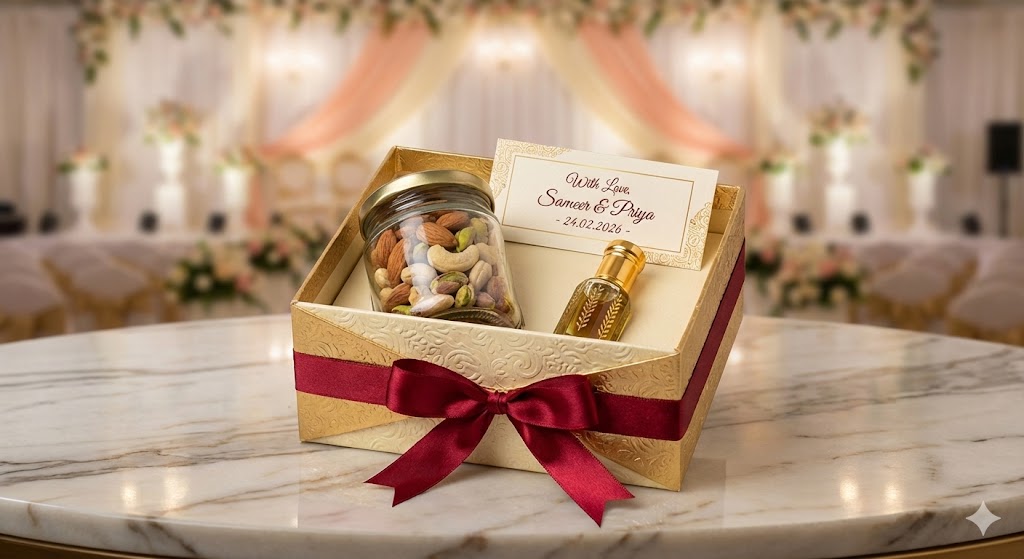
The practical guide:
-
For mixed-religion guest lists: Stick to dry fruits, brass/copper items, premium sweets without religious symbols. Safe, beautiful, appreciated by all
-
For South Indian guests at a North Indian function: Include Thamboolam-inspired items (betel leaves, kumkum) alongside your North Indian gifts. The recognition will be deeply appreciated
-
For Muslim guests at Hindu functions: Ensure food items are halal. Skip alcohol-based fragrances. Include dates or sewaiyan if possible
-
For international/NRI guests: Quality regional craft items (Rajasthani block print, Bengal dokra, Karnataka sandalwood) communicate India’s cultural richness to someone experiencing it from outside
Final Thought: India’s Return Gift Is a Living Map
That building in Dadri taught me something I’ve carried into every event I’ve hosted since: India’s return gift traditions are not separate systems. They are one continuous conversation about hospitality, conducted in dozens of different dialects.
When my Punjabi neighbor pressed dry fruits and a shagun coin into my hands after their daughter’s wedding, and when the Tamil aunty upstairs handed me a carefully wrapped Thamboolam packet after their son’s thread ceremony, and when the Lucknow family sent sewaiyan home with us after Eid—they were all saying exactly the same thing.
You came. You blessed us. Carry something of this joy with you.
The languages are different. The intention is identical. And understanding both makes every cross-cultural interaction richer, every return gift more meaningful, and every occasion—regardless of whose tradition it follows—more genuinely Indian.
Which regional return gift tradition have you encountered that surprised or moved you? Share in the comments—these cross-cultural gifting moments are some of the most beautiful stories Indian social life produces!